
Alexander Zverev vs Rafael Jódar Prediction
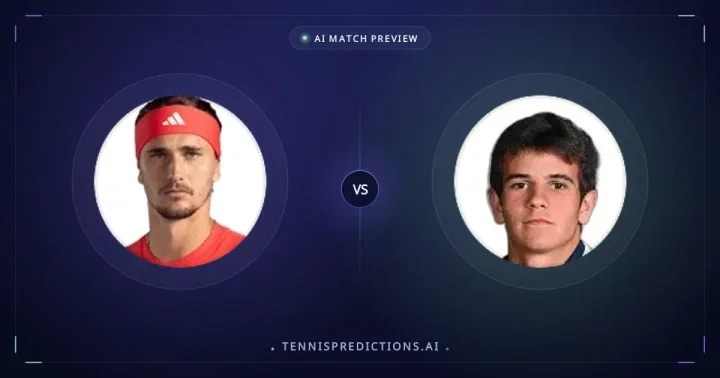
The price alone does not reveal how fast Rafael Jódar has closed the gap on the established elite. He began 2026 at World No. 165, reached a career-high No. 10 on 2 November and qualified for Turin one year after competing at the Next Gen ATP Finals. The Alexander Zverev vs Rafael Jódar prediction therefore asks whether a remarkable rise can survive its sternest indoor test against the World No. 1.
Zverev still owns the stronger numerical case. His 65-18 season includes two Grand Slam titles, a 36-12 hardcourt record and a previous straight-sets victory over Jódar. Their Group A match is scheduled for Sunday at one o’clock UTC, with Ben Shelton and Arthur Fils completing the John McEnroe Group.
Sixty-five wins underpin Zverev’s favorite status
The résumé is substantial. Zverev’s 65 victories from 83 matches produce a season win rate above 78%, while his 36-12 hardcourt record means he has won three quarters of his matches on the surface used in Turin. Those numbers make 1.42 understandable before his major results or tournament history are even considered.
Two Grand Slam trophies separate Zverev’s season from Jódar’s breakthrough campaign. The German won the French Open and US Open in 2026, proving his level across clay and hard courts while navigating best-of-five matches against the deepest fields on the calendar. Turin uses best-of-three scoring, but a player who has completed two title runs at majors has repeatedly handled the pressure attached to late-round matches.
Zverev also enters as the World No. 1 and top seed. Jódar’s No. 10 ranking is impressive after starting the year at No. 165, yet the gap between first and tenth matters when it is supported by 20 more seasonal victories: Zverev is 65-18, while Jódar is 45-19. The favorite has played 19 more matches and lost only one more.
Their only previous meeting gives Zverev another concrete advantage. He beat Jódar 7-6(3), 6-1, 6-3 in the French Open quarterfinals on 2 June, taking the opening tiebreak before conceding just four games across the next two sets. Clay is not the same assignment as an indoor hardcourt, so the result cannot settle the Turin match by itself, but a 7-6(3), 6-1, 6-3 score shows Zverev already found a successful route through this opponent over three sets.
The first set in Paris carries particular weight because it was the competitive part of that match. Zverev won its decisive tiebreak 7-3 and then controlled the remaining sets, a progression that supports him if Sunday begins with few breaks. Jódar needs to stop one tight set from becoming the platform for another Zverev surge.
Turin is familiar territory for the German. His ATP Finals titles in 2018 and 2021 mean he is seeking a third year-end championship, whereas Jódar is making his debut. Past titles do not award a single point in the current round-robin stage, but two completed championship runs provide relevant evidence that Zverev has produced winning tennis under this event’s compressed best-of-three format.
One caution sits in Zverev’s latest result. Lorenzo Musetti beat him 7-6(5), 6-2 in the Paris Masters round of 32 on 2 November, with a close first set followed by a one-sided second. The parallel with Zverev’s French Open win over Jódar is notable: both matches swung after an opening tiebreak, making the early high-pressure points a plausible hinge in Turin.
A 155-place climb keeps Jódar’s upset route open
Jódar has earned his place. His rise from No. 165 to No. 10 during one season was accompanied by a 45-19 record and his first ATP title in Marrakech, so his qualification was built on sustained results rather than one isolated tournament. A player winning more than 70% of 64 matches cannot be dismissed merely because the opposite side carries the top seed.
His Basel opener supplies a useful recent hardcourt example. Jódar defeated Alejandro Tabilo 6-4, 6-2 on 27 October, losing only six games in a straight-sets result. The score supports an upset argument because it shows he could turn one close set into a more comfortable second set, precisely the sequence he must prevent Zverev from producing against him.
The larger career pattern is even harder to ignore. Jódar became the first player since Carlos Alcaraz to qualify for the ATP Finals one year after appearing at the Next Gen ATP Finals, and his 155-place climb reached its peak when he became World No. 10 on 2 November. Rapid progress does not guarantee another step against the top-ranked player, but it makes 2.90 more credible than the label of tournament debutant might suggest.
Jódar has also identified persistence as central to his season, saying after qualification that his mindset of not giving up and giving everything in every match helped him reach Turin. His 45 wins support the substance behind that comment, while the 7-6(3) first set against Zverev in Paris shows he has already stayed level with the German for a full set. If he converts a similarly competitive opening into a set rather than a tiebreak loss, the best-of-three format leaves Zverev much less recovery room than their French Open quarterfinal allowed.
Recent form introduces a counterweight. Casper Ruud beat Jódar in straight sets in the second round of the Paris Masters in his final match before Turin, while Zverev also arrived after a straight-sets Paris defeat to Musetti. Neither player therefore brings a winning result directly into the Finals, although Jódar’s earlier 6-4, 6-2 victory over Tabilo gives him a recent straight-sets hardcourt win to place beside that loss.
Jódar’s strongest path starts with reversing the first-set detail from their only meeting. The 20-year-old reached 6-6 against Zverev before losing the tiebreak 3-7; winning those four additional tiebreak points would alter the score pressure of a best-of-three match. His upset price becomes viable if his improvement from No. 165 to No. 10 translates into better execution at the same stage.
The pick would look wrong if Jódar takes the opening set and forces Zverev to chase. A debutant with a 45-19 season and a title already secured has enough winning evidence to exploit that position.
The 1.42 price reflects achievement, not certainty
The market makes Zverev a clear favorite at 1.42, with Jódar offered at 2.90. Those prices correspond to raw implied probabilities of roughly 70.4% and 34.5% before accounting for the bookmaker’s margin, so bettors are being asked to treat the German as substantially more likely than not to win.
There is a firm basis for that assessment. Zverev leads the seasonal win count 65 to 45, owns a 36-12 hardcourt record, holds the No. 1 ranking and won their previous meeting in straight sets. His two major titles and two previous ATP Finals trophies add evidence from the highest-pressure tournaments, while Jódar is facing the year-end championship for the first time.
The case is not overwhelming enough to treat 1.42 as risk-free. Zverev’s 7-6(5), 2-6 loss to Musetti in Paris was recent, and Jódar’s 155-place ranking rise makes his current No. 10 status more relevant than where he started the season. The Spaniard’s 2.90 price acknowledges both his lower baseline chance and the possibility that his development has moved faster than the market can cleanly measure.
Our AI Tennis Predictions lean toward the established player, but the degree of conviction is only moderate rather than forceful. Zverev has the superior body of work; Jódar’s rapid ascent and competitive first set in Paris stop the selection from reaching a higher confidence tier.
Our pick is Alexander Zverev to win at odds of 1.42.
The 1.42 is fairest when read as a price on repeatable advantages rather than reputation. Zverev’s 65-18 record represents 83 matches of evidence, his 36-12 hardcourt mark directly matches the surface category, and his 7-6(3), 6-1, 6-3 win establishes a successful precedent against Jódar. Each element points in the same direction, even though none eliminates the outsider’s chance.
The total-games lean is under 29.5 at 1.31, a high line for a best-of-three match that can stay below the threshold even with one long set. Zverev’s previous 7-6(3), 6-1, 6-3 victory totaled 29 games over three sets, while Jódar’s 6-4, 6-2 Basel win and both players’ latest straight-sets losses illustrate several routes to a shorter contest.
Price sensitivity matters most on the side. Jódar at 2.90 needs his 45-19 season, first ATP title and rise to No. 10 to outweigh a direct defeat and Zverev’s stronger hardcourt record; Zverev at 1.42 needs only to reproduce the broad level behind 65 wins, two majors and the top ranking. The favorite’s price is short, but the numerical burden placed on him is still lower than the performance leap required from the debutant.