
Alexander Zverev vs Terence Atmane Prediction
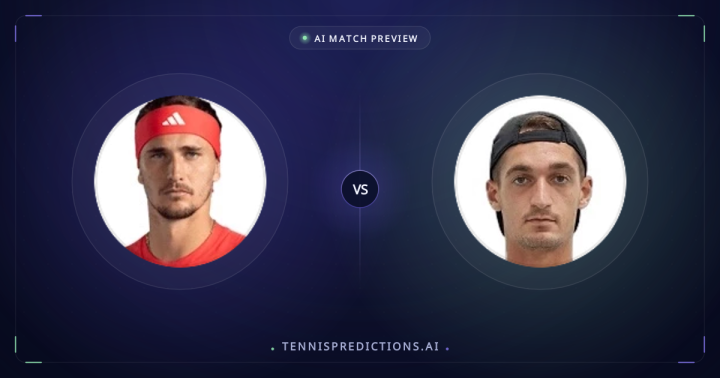
Alexander Zverev vs Terence Atmane Tennis Tips
Alexander Zverev and Terence Atmane meet in a fascinating ATP Cincinnati clash, and from a tennis betting perspective, this is a matchup with a clear favorite but enough stylistic intrigue to make the markets worth studying carefully. Zverev is priced at 1.14 to win, while the underdog side is available at around 6.20, reflecting the wide gap in ranking, experience, consistency, and big-match pedigree. TennisPredictions.ai’s AI model points strongly toward Zverev as the best match winner selection, rating the pick with a confidence score of 10.0/10 at odds of 1.14.
The recommended total games angle is Under 28.5 games at odds of 1.27, which suggests the market expects Zverev to control the match without being dragged into a long three-set battle. That does not necessarily mean Atmane cannot be competitive in patches. The Frenchman is talented, dangerous, and has a game style that can create awkward moments. However, over a full match, Zverev’s serve, backhand stability, defensive reach, and Masters 1000 experience make him the more reliable betting option.
Best Tip: Alexander Zverev to win
Match Overview
This ATP Cincinnati meeting brings together one of the most established elite players on the men’s tour and one of the more exciting left-handed talents trying to push deeper into the top tier. Zverev enters the contest as the superior name on paper. He has been a regular presence in the latter stages of Masters 1000 events, Grand Slams, and ATP Finals tournaments, and his ability to produce a high baseline level on hard courts is one of the reasons bookmakers have placed him as a strong favorite.
Atmane, meanwhile, comes into this match with a very different profile. He is not as proven as Zverev, but he is not a player to dismiss casually. The Frenchman has already shown that Cincinnati can be a special venue for him, having previously produced a major breakthrough run here. That kind of positive memory matters in tennis. Some players simply feel comfortable at certain events because of the court speed, ball bounce, conditions, and atmosphere. Atmane appears to enjoy the Cincinnati environment, and that makes him a more interesting underdog than the odds alone might suggest.
Still, betting is about probability rather than romance. Zverev’s price of 1.14 indicates a very high implied probability, and that is understandable. He has the superior serve, the more dependable backhand, the greater physical presence, and significantly more experience against top-level opposition. When a player like Zverev is expected to win, the question for bettors often becomes whether the moneyline price has enough value or whether alternative tennis betting markets such as total games, set betting, handicaps, or correct score provide a better route.
Recent Form and Momentum
Alexander Zverev’s form
Zverev arrived in Cincinnati looking to rebuild momentum after a frustrating earlier exit in Montreal. That kind of result can sometimes create doubts around a top player, but it can also sharpen focus. In Cincinnati, after receiving a first-round bye, Zverev had to work hard in his opening match against Cameron Norrie. He dropped the first set 3-6 and looked somewhat out of rhythm early, but his response was important. He adjusted, raised his serving percentage, became more assertive from the baseline, and eventually came through 3-6, 6-3, 6-3.
From a betting analysis point of view, that win offered both a warning and a positive sign. The warning is that Zverev did not start at his best. Against an unpredictable left-hander like Atmane, a slow start could lead to a tight opening set. The positive is that Zverev showed problem-solving ability and physical composure. He did not panic after falling behind, and once he found his level, the match turned clearly in his favor.
That is often what separates established elite players from rising talents. Even when Zverev is below his best, he has enough weapons to recover. His serve gives him free points, his backhand rarely breaks down under pressure, and his court coverage makes opponents hit one extra shot. Those qualities are especially useful on hard courts, where consistent first-strike tennis usually wins over time.
Terence Atmane’s form
Atmane has been enjoying one of the best periods of his career. His climb toward the top 50 reflects improved consistency, stronger belief, and better results on the main tour. He reached this stage in Cincinnati after benefiting from a first-round retirement by Marton Fucsovics, then battling past Tomas Martin Etcheverry in a gritty second-round contest.
That win over Etcheverry was important because it showed Atmane can handle a physical baseline battle. Etcheverry is not an easy opponent to hit through, and beating him requires patience, shot tolerance, and intelligent point construction. Atmane’s victory suggests he is not simply a flashy shot-maker; he is developing into a more complete competitor.
The challenge now is a major step up. Zverev is not just another powerful baseliner. He is one of the best returners and defensive movers among tall players in the modern game. Atmane will need to serve well, protect his second serve, and avoid giving Zverev too many neutral rallies. If he gets dragged into repetitive backhand-to-backhand exchanges or extended baseline patterns, the advantage will swing heavily toward the German.
Playing Style Breakdown
Alexander Zverev’s strengths
Zverev is built around a classic elite hard-court profile: big serve, reliable backhand, heavy baseline depth, and excellent movement for his height. His first serve is one of his biggest weapons. When he lands it at a high percentage, he can cruise through service games, apply scoreboard pressure, and make opponents feel that one poor service game could decide a set.
His two-handed backhand is arguably his signature shot. It is compact, powerful, and extremely stable. Zverev can redirect it down the line, trade cross-court with precision, or absorb pace from aggressive opponents. Against a left-hander like Atmane, this backhand becomes even more important because it will often be tested by Atmane’s heavy forehand patterns.
Another key strength is Zverev’s ability to defend from deep positions without losing control of the rally. Many big servers are vulnerable when forced to move laterally, but Zverev can slide, stretch, and reset points. That makes it difficult for underdogs to win quickly unless they are striking the ball with exceptional accuracy.
Terence Atmane’s strengths
Atmane brings a very different type of danger. He is a creative left-hander with a heavy, spin-loaded forehand and a serve that can open up awkward angles. His lefty delivery, especially when used wide on the ad court, can drag right-handed opponents off the court and set up first-strike forehands into open space.
His game is less predictable than Zverev’s. That can be a strength. Atmane can change pace, use angles, flatten out winners, and disrupt rhythm. Against a player who likes structured baseline exchanges, variety can be a useful weapon. If Atmane can keep Zverev uncomfortable and avoid falling into predictable rally patterns, he can make the match more competitive than the odds imply.
The concern is execution. Creative tennis is powerful when timing is sharp, but it can also produce errors. Against Zverev, low-percentage shot selection can quickly become costly. Zverev’s defense forces opponents to hit close to the lines repeatedly, and that is difficult to sustain across two or three sets.
Tactical Matchup
The key pattern in this match is likely to be Zverev’s backhand versus Atmane’s lefty forehand. Atmane will naturally want to use his forehand cross-court to push the ball high and heavy into Zverev’s backhand corner. Against many right-handers, that is a profitable pattern. But Zverev’s backhand is not an ordinary wing. He can handle pace and spin better than most, and he is comfortable trading from that side for long periods.
Atmane’s serve direction will also be crucial. If he can consistently pull Zverev wide with the lefty slice serve, especially on the ad side, he can create open-court opportunities. However, Zverev’s return position and reach may reduce the effectiveness of that tactic. Zverev does not need to attack every return; he simply needs to make enough balls back deep to start neutral rallies, where his consistency should take over.
On Zverev’s serve, Atmane faces an even tougher assignment. The German can hit flat serves up the T, kick serves wide, and use body serves to jam opponents. If Zverev earns a high number of cheap points behind his first serve, Atmane will be forced to take more risks in his own service games. That is often when break chances arrive.
The matchup could become close if Zverev’s first-serve percentage drops or if Atmane starts landing early forehand winners. But over time, Zverev has more reliable routes to winning points. He can win with the serve, win from the baseline, defend when necessary, and attack short balls. Atmane likely needs a peak serving day and a high winner-to-error ratio to threaten the upset.
Statistical Betting Analysis
The odds tell a clear story. A price of 1.14 on Zverev implies that bookmakers view him as a heavy favorite. In betting terms, this is not a speculative underdog spot. It is a matchup where the market strongly respects the difference in class.
At 6.20, Atmane is priced as a long shot. That number reflects his lower ranking profile, limited experience at the deepest level of Masters 1000 events, and the difficulty of beating a player like Zverev on hard courts. Underdog bettors may be tempted by the bigger payout, especially because Atmane is a left-hander with confidence in Cincinnati. However, value is not just about big odds. The selection must have a realistic probability of landing, and Zverev’s advantages are substantial.
The Under 28.5 games market at 1.27 is also logical. For this line to lose, the match likely needs one of several scenarios: three competitive sets, two extremely tight sets such as 7-6 7-6, or Atmane winning a set and forcing a longer contest. While not impossible, those outcomes require Atmane to hold serve at a very high rate and avoid a dip in level. Against Zverev’s return pressure and baseline consistency, that is a difficult ask.
A Zverev win in straight sets would likely keep the match under 28.5 games in most scorelines. For example, 6-4 6-4, 6-3 6-4, 6-4 6-2, or 7-5 6-3 all land under the total. Even a moderately competitive match can stay below the number if Zverev avoids a tiebreak-heavy contest.
Why Zverev Is the Top AI Prediction
TennisPredictions.ai’s AI selection is Zverev to win, with a confidence score of 10.0/10. That kind of rating is not based on hype alone. Statistical models typically weigh factors such as ranking strength, recent results, surface performance, service hold rates, return efficiency, opponent quality, and historical consistency in similar matchups.
Zverev grades well in most of those categories. He is more proven on hard courts, more experienced in Masters 1000 environments, and more likely to maintain a stable level across the match. Atmane’s upside is real, but his path to victory is narrower. He needs to serve brilliantly, disrupt rhythm, and convert rare break chances. Zverev, by contrast, can win even without playing at his absolute maximum.
The AI’s confidence also aligns with the betting market. Odds of 1.14 do not offer huge profit on their own, but they do signal strong expected dominance. For bettors seeking safer tennis tips, Zverev moneyline is the obvious pick. For those looking to improve returns, combining Zverev to win with Under 28.5 games may be a more aggressive angle, though it naturally increases risk.
Total Games Prediction: Under 28.5
The Under 28.5 games prediction is attractive because it fits the likely match script. Zverev should win the majority of his service games comfortably, and Atmane may struggle to match that efficiency across the entire contest. If Zverev breaks once in each set, the under becomes very reachable.
Atmane’s left-handed serve can help him stay competitive, but Zverev’s return game is strong enough to create pressure. The German does not need to dominate every return game. He only needs a few strong return points at 30-30 or deuce to tilt the scoreboard. Once Zverev gets ahead, his serve usually allows him to protect the lead.
The main risk to the under is an extended opening set. If Atmane starts hot and forces a tiebreak, the total games line becomes more vulnerable. Still, even a 7-6 first set does not automatically kill the under if the second set is one-sided. A score like 7-6 6-3 still lands under 28.5. The real danger is a three-set match or two tiebreaks, and the probability of that appears lower than the probability of Zverev winning in a controlled manner.
Possible Scoreline
A reasonable projected scoreline is Zverev winning 6-4 6-3 or 6-4 6-4. These outcomes respect Atmane’s ability to hold serve and create moments of pressure, but they also reflect Zverev’s greater consistency and superior match management.
Atmane may well produce highlight points and could push one set deep if his serve is firing. However, Zverev’s ability to absorb pressure and punish loose games should be decisive. The German is particularly effective when he gets into return games and forces opponents to play under scoreboard stress. For a rising player like Atmane, that pressure can lead to a few rushed forehands or missed second-serve patterns.
Betting Verdict
This is a classic favorite-versus-dangerous-underdog matchup. Atmane has the talent, lefty patterns, and Cincinnati confidence to make parts of the match entertaining. He is not just a passive opponent waiting to be beaten. His forehand spin, creative shot-making, and tactical variety could cause Zverev some discomfort, especially early.
But when making a tennis prediction, the safest conclusion is that Zverev has too many advantages. He owns the stronger serve, the better backhand, the higher defensive ceiling, and the more reliable big-match temperament. His recovery win against Norrie also suggests he is already adjusting to conditions and building rhythm.
For betting enthusiasts, Zverev to win is the standout selection, while Under 28.5 games is a logical secondary market for those expecting the favorite to take control before the match becomes too extended.
Best Tip: Alexander Zverev to win
Secondary Tip: Under 28.5 total games
Final Prediction
Alexander Zverev should advance, but the match may not be completely routine from the first ball. Terence Atmane’s left-handed game gives him enough tools to create awkward patterns, and his positive history in Cincinnati adds confidence. Still, over two or three sets, the German’s superior baseline stability and serving power should prove too much.
The most likely outcome is a professional Zverev victory in straight sets, with Atmane competing well in spells but failing to sustain the level required for a major upset. The AI prediction, bookmaker odds, and tactical matchup all point in the same direction: Zverev is the correct tennis betting pick, and the total games under also has solid statistical support.
Prediction: Alexander Zverev to win.
Expected score: 6-4 6-3.