
Andrey Rublev vs Tomas Martin Etcheverry Prediction
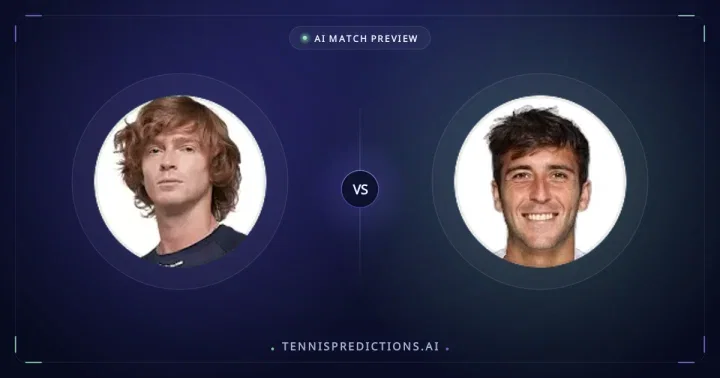
Paris offers Andrey Rublev an immediate test of whether his stronger hard-court season can outweigh two subdued October defeats. The Andrey Rublev vs Tomas Martin Etcheverry prediction points toward the Russian in Tuesday’s first-round match, scheduled for ten o’clock UTC on an indoor hard court. Our pick is Andrey Rublev to win at 1.38. The price is short. Confidence is notably restrained, however, with the assessment sitting near the bottom of the scale rather than presenting Rublev as an automatic selection.
Rublev owns the firmer hard-court foundation
Hard-court records separate them. Rublev has gone 18-14 on the surface in 2026, while Etcheverry has managed an 8-14 record, giving the favorite ten more wins and a winning percentage above 56% compared with the Argentine’s mark below 37%. A first-round price of 1.38 can be defended by that difference, even if it leaves little room for a slow opening set or another uneven performance from the Russian.
Rublev’s overall 34-22 record across 56 matches this season supplies a broader base for the favorite’s position. His ranking of No. 22 is also seven places better than Etcheverry’s No. 29, although the gap is modest enough to discourage treating this as a severe mismatch. Rublev fell outside the top 10 during 2026 after finishing every season from 2020 through 2024 inside that group, so his current standing reflects a clear retreat from his established level rather than a career peak.
One title remains significant. Rublev won the Swedish Open in Bastad on clay during 2026, and lifting that trophy shows his season has contained a complete tournament run despite the ranking decline. Etcheverry’s available hard-court numbers provide less support for an upset at 3.05 because his 8-14 record means he has lost almost twice as often as he has won on the surface this year.
Their Montreal meeting offers the closest surface comparison. Rublev defeated Etcheverry 7-6(3), 6-2 on hard court at the National Bank Open in August 2024, winning the first-set tiebreak before opening a much wider margin in the second. I trust that Montreal result more than Etcheverry’s later victory on grass, while placing less trust in the Halle outcome because Tuesday’s match returns them to the surface on which Rublev recorded the straight-sets win.
Readers who also bet beyond tennis can find AI football predictions, but the relevant betting case here stays narrow: Rublev’s 18-14 hard-court record, the 7-6(3), 6-2 Montreal score and his No. 22 ranking all support the favorite.
October losses keep the favorite vulnerable
Recent form still matters. Rublev lost 5-7, 2-6 to Tommy Paul in Vienna on October 27 after also losing to Adrian Mannarino in the Almaty round of 16 on October 19, so his last two recorded tournaments ended without a sustained run. The Vienna score is especially uncomfortable for anyone taking 1.38 because a competitive opening set was followed by a second set in which Rublev won only two games.
Etcheverry arrives with comparable problems rather than obvious momentum. His October 21 match in Almaty ended in a 5-7, 4-6 defeat to Mattia Bellucci, and his October 26 appearance in Vienna produced a 3-6, 4-6 loss to Matteo Berrettini. Four consecutive lost sets across those two matches weaken the case for backing him at 3.05, but they do not remove the risk attached to a favorite who also lost his latest two events.
The danger is real. Their ATP Tour series stands at 1-1 because Etcheverry beat Rublev in three sets on the Halle grass in June 2025, proving he has already found a route past Tuesday’s favorite. Surface context prevents that result from carrying the same weight as Montreal, yet a tied head-to-head is enough to challenge any suggestion that 1.38 represents a routine formality.
Rublev’s victory price is therefore supported more by comparative hard-court performance than by current momentum. An under 29.5-games lean at 1.27 fits the best-of-three format and the possibility of a straight-sets result, but its compressed price offers even less margin for a long set or a decider. The winner advances to face eighth seed Alex de Minaur, adding a demanding second-round assignment without changing the immediate question: whether Rublev can turn the season-long surface advantage into his first win after consecutive October exits.