
Coco Gauff vs Marta Kostyuk Prediction
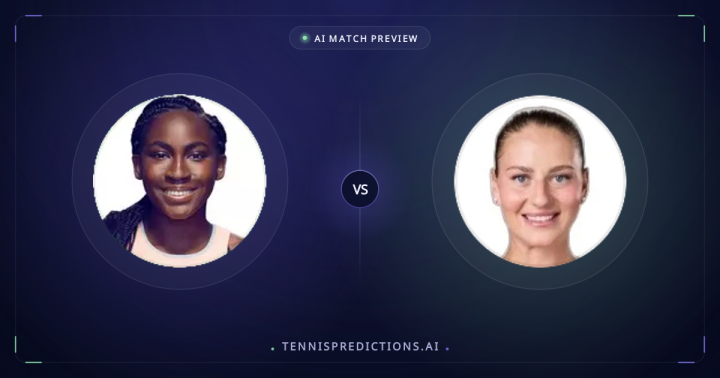
Gauff vs Kostyuk Betting Preview
Coco Gauff and Marta Kostyuk meet in what has all the ingredients of a gripping WTA Cincinnati quarterfinal, with the match scheduled for 2026-08-22 at 01:30:00 UTC. This is not just another hard-court contest on the road to the US Open. It is a meeting between two players who bring very different weapons, rhythms, and competitive personalities to the court.
Gauff, seeded No. 4, arrives as one of the biggest names in the women’s game and a former Cincinnati champion. Kostyuk, seeded No. 10, enters this clash with growing momentum and the confidence of a player breaking new ground at this event. For bettors searching for tennis tips, WTA predictions, Cincinnati Open betting analysis, and AI tennis predictions, this matchup is especially interesting because the market and the model do not completely agree on how straightforward it should be.
The betting odds currently price Coco Gauff at 1.77 to win, while Marta Kostyuk is available at 2.32. That makes Gauff the favorite, but not an overwhelming one. TennisPredictions.ai has identified Kostyuk to win as the top prediction, listed as “2” for the second player, with odds of 2.32. However, the confidence score is only 2.2/10, which is an important detail. The model sees value on the underdog, but it is not presenting this as a high-certainty selection.
For the total games market, the suggested line is under 28.5 games at odds of 1.26. That is a much shorter price, but also a bet that fits several logical match scripts: a straight-sets win for either player, a one-sided deciding set, or a tight two-setter that still stays below the number.
Best tip: Under 28.5 total games at 1.26
Match Context And Stakes
The Cincinnati Open is one of the most important WTA 1000 events on the calendar, particularly because of its timing. It comes just before the US Open, meaning elite players use it both as a title opportunity and as a final high-level test before the year’s last Grand Slam.
For Gauff, Cincinnati carries special meaning. She has already lifted the trophy here in the past, and American crowds usually bring extra energy to her matches. Playing in the United States often suits her: the atmosphere is familiar, the support is strong, and the hard courts reward her speed, athleticism, and defensive range.
For Kostyuk, this quarterfinal represents another marker of her rise. Making a first quarterfinal appearance at Cincinnati is a meaningful step, especially at a WTA 1000 event filled with top-tier opponents. She has long been known for her explosive ball-striking and intensity, but her results have become more consistent as her decision-making and point construction have matured.
From a betting perspective, this is the kind of match where name value matters. Gauff naturally attracts public support because she is a Grand Slam champion, a major American star, and a proven performer at this venue. Kostyuk, however, is dangerous at underdog odds because she can take the racket out of her opponent’s hands when her timing is sharp.
Odds Analysis: What The Market Is Saying
The moneyline odds show a competitive but clearly defined market:
Coco Gauff to win: 1.77
Marta Kostyuk to win: 2.32
At 1.77, Gauff is being priced as the more likely winner, but the odds are not short enough to suggest total dominance. The market is respecting her ranking, track record, athletic profile, and previous Cincinnati success, while still leaving room for Kostyuk’s upside.
At 2.32, Kostyuk is positioned as a live underdog. That number suggests the market believes she has a real path to victory, especially if she can dictate rallies early and prevent Gauff from settling into long defensive exchanges.
The AI prediction favoring Kostyuk is notable because it goes against the favorite. In betting terms, that often means the model is looking for value rather than simply identifying the most likely winner. A player can be less likely to win overall but still be a better bet if the odds are considered too generous. However, the low confidence score of 2.2/10 should make bettors cautious. This is not a model screaming certainty; it is more of a value lean.
The total games line of under 28.5 at 1.26 is a different type of betting angle. It does not require choosing the winner. Instead, it asks whether the match is likely to stay below a very high games threshold. In women’s best-of-three tennis, 28.5 is a large number. A match can go three sets and still land under, depending on the scoreline. For example, 6-4, 3-6, 6-3 totals 28 games, still under 28.5. That gives the under some breathing room.
Recent Form: Gauff Building Rhythm
Gauff comes into this quarterfinal on a three-match winning streak in Cincinnati. Her campaign has not been completely smooth, but that may actually make her more dangerous. Early in the tournament, she had to recover from a rough start against Liudmila Samsonova, losing the opening set 2-6 before finding her level and winning 2-6, 6-4, 6-1. That type of comeback matters because it shows resilience, problem-solving, and the ability to raise her physical and mental intensity once under pressure.
After that test, Gauff looked more settled. She defeated Ann Li in straight sets, an important result because clean wins help conserve energy during a demanding WTA 1000 schedule. Then, in the Round of 16, she produced one of her most professional performances of the week by beating No. 22 seed Marie Bouzková 6-3, 6-2.
The Bouzková match is particularly relevant for bettors. Bouzková is known for consistency, court coverage, and forcing opponents to earn points. Gauff handled that challenge efficiently. The detail that stands out is that she saved all eight break points she faced. That kind of clutch serving under pressure can swing a match, especially against an aggressive opponent like Kostyuk who will attack second serves and look to apply scoreboard pressure.
Gauff’s form profile, then, is mixed but encouraging. She had one shaky set, responded strongly, and has since played cleaner tennis. The main question is whether her serve and forehand hold up against a player who hits heavier and flatter than many opponents.
Recent Form: Kostyuk Surging At The Right Time
Kostyuk also arrives with three straight wins, and her Cincinnati run has the added intrigue of being her first quarterfinal appearance at the tournament. That kind of breakthrough can be emotionally powerful. Players often speak about gaining belief at specific venues once they finally put together a deep run, and Kostyuk’s hard-court game is well suited to Cincinnati conditions.
Her momentum matters because Kostyuk is a confidence-based attacker. When she is landing first strikes, stepping inside the baseline, and controlling exchanges with her backhand and forehand, she can rush even elite defenders. She does not want rallies to become predictable or extended. She wants to hit through the court, change direction quickly, and make her opponent feel late to the ball.
That playing style gives her a genuine route against Gauff. Many players struggle to finish points against the American because Gauff’s movement is elite. She can turn defense into offense in one shot, and she forces opponents to hit extra balls. Kostyuk’s challenge is to stay aggressive without becoming reckless. If she overhits, Gauff’s consistency and counterpunching can quickly take over. If Kostyuk finds the balance, she can keep the match on her terms.
The odds of 2.32 reflect that possibility. Kostyuk is not being treated like a long shot. She is priced as a capable underdog whose ceiling is high enough to trouble the favorite.
Playing Style Breakdown
This match is a classic contrast between defensive excellence and aggressive ball-striking.
Gauff’s strengths are obvious: elite movement, defensive reach, strong backhand, competitive toughness, and the ability to extend rallies until opponents make mistakes. She is one of the best athletes on the WTA Tour, and her court coverage can be frustrating for big hitters. Shots that would be winners against many players often come back against Gauff, forcing opponents to take more risk.
Her backhand is also a major weapon. It is stable, deep, and effective both cross-court and down the line. When Gauff is confident, she can redirect pace beautifully from that wing. Her serve can produce free points, but it can also fluctuate. Double faults and second-serve vulnerability have been issues at different stages of her career, so Kostyuk will likely look to attack whenever she gets a look at a softer delivery.
Kostyuk’s game is more explosive. She likes to step forward, take the ball early, and shorten points. Her backhand can be especially damaging when she is timing it well. She has the power to hit through defensive players, but the risk is error count. Against someone like Gauff, impatience can become costly.
The tactical question is simple: who controls the rally length? If Gauff can stretch points beyond four or five shots and make Kostyuk hit from uncomfortable positions, the favorite’s chances improve. If Kostyuk consistently gets the first strike and keeps Gauff defending rather than counterattacking, the underdog becomes very dangerous.
Key Betting Factors
The first key factor is Gauff’s serve under pressure. In her win over Bouzková, saving eight break points was a statement. But saving break points is not always repeatable. Against Kostyuk, who is likely to be more aggressive on return, Gauff may not be able to escape every danger game. If her first-serve percentage is high, she can protect herself. If it drops, Kostyuk will have chances.
The second key factor is Kostyuk’s error management. She does not need to play safe tennis, because that would likely favor Gauff. But she does need to choose her moments. Attacking the open court, stepping in on short balls, and targeting Gauff’s forehand can work. Going for low-percentage winners too early in rallies may not.
The third factor is emotional control. Both players are intense competitors. Gauff will have home support, which can lift her, but it can also add pressure. Kostyuk has the advantage of playing with underdog freedom, but she must avoid frustration when Gauff retrieves balls that look impossible to defend.
The fourth factor is the total games line. Under 28.5 is a high threshold, and it is often attractive in women’s tennis when two players have the ability to generate momentum swings. If one player wins in straight sets, the under is very likely. Even many three-set matches stay below 29 games unless there are multiple 7-5 or 7-6 sets.
AI Prediction And Confidence Score
TennisPredictions.ai lists the top prediction as Marta Kostyuk to win, with a confidence score of 2.2/10 and odds of 2.32. This is an interesting signal but should be interpreted carefully.
A low confidence score means the matchup is volatile. The model may see value in Kostyuk’s price, but it is not suggesting that she is a strong lock. In betting language, this is closer to a speculative value play than a banker pick. Kostyuk’s odds are attractive because she has the tools to beat Gauff, but the risk is obvious: Gauff is higher ranked, more proven at Cincinnati, and extremely difficult to hit through when she is physically and mentally locked in.
For bettors building a staking plan, that distinction matters. A small stake on Kostyuk at 2.32 may appeal to those seeking plus-money value. However, the safer angle appears to be the total games market, where under 28.5 at 1.26 provides more ways to win.
Best tip: Under 28.5 total games at 1.26
Why Under 28.5 Games Makes Sense
The under 28.5 games selection is supported by several logical scoreline paths. In a best-of-three WTA match, the line is generous. A straight-sets result almost always lands under unless both sets are extremely long, such as 7-6, 7-6, which totals 26 anyway and still stays under. That is important: even two tiebreak sets do not beat this line.
To go over 28.5, the match usually needs three competitive sets with at least one extended set. Examples include 7-6, 4-6, 6-4, which totals 33 games, or 7-5, 5-7, 6-4, which totals 34. But not every three-set match goes over. Many common three-set scores stay under, including 6-3, 4-6, 6-3 or 6-4, 3-6, 6-3.
This matters because both Gauff and Kostyuk are capable of producing one-sided sets. Gauff can run away with sets when opponents lose patience. Kostyuk can also string together quick games if her first-strike tennis is landing. Their styles create potential for momentum swings, but not necessarily marathon scoring.
The odds of 1.26 are short, so this is not a high-payout pick. Still, from a tennis betting tips perspective, it is the most practical angle because it does not depend on correctly identifying the winner in a matchup with legitimate uncertainty.
Moneyline Prediction: Is Kostyuk Worth The Risk?
Kostyuk at 2.32 is tempting. The AI model likes her as the top prediction, and her aggressive profile gives her a clear path. She can attack Gauff’s second serve, take time away, and prevent the American from settling into long rallies. If she starts fast, she can put pressure on Gauff immediately.
However, there are reasons not to overstate the underdog case. Gauff has already shown strong problem-solving this week. Coming back from a poor first set against Samsonova and then delivering a clinical win over Bouzková suggests she is trending in the right direction. She also has the Cincinnati pedigree and the crowd support.
The fairest moneyline read is that Gauff deserves favorite status, but Kostyuk is not overpriced. Bettors who like underdog value may find 2.32 appealing, especially if they believe Kostyuk’s power will rush Gauff. More conservative bettors may prefer to avoid the winner market and focus on totals.
If forced to choose a winner, the value angle leans slightly toward Kostyuk because of the odds and the AI recommendation. But the confidence level is too low to make it the strongest betting pick.
Possible Match Scripts
One realistic script is a Gauff win in two sets. In this version, Gauff absorbs Kostyuk’s pace, extends rallies, and gradually draws errors. Her movement frustrates Kostyuk, and her break-point toughness proves decisive. A score like 6-4, 6-3 or 7-5, 6-3 would comfortably support the under 28.5 games tip.
Another possible script is a Kostyuk upset in two tight sets. If the Ukrainian lands her returns early and keeps attacking, she can prevent Gauff from controlling the tempo. A score like 7-5, 6-4 or 6-4, 7-5 would also stay under the total.
A third script is a three-set match with momentum swings. This may feel likely because both players are in form, but even then, the under can survive depending on the set scores. A 6-3, 3-6, 6-4 result totals 28 games, which still cashes the under 28.5.
The danger for the under is a match with multiple long sets, such as 7-6, 5-7, 6-4. That is possible, especially if both players serve well and struggle to separate. But given the return pressure each can create and the likelihood of momentum runs, the under remains the preferred betting angle.
Final Betting Verdict
This Cincinnati quarterfinal is a fascinating matchup for tennis bettors because it combines star power, form, stylistic contrast, and a live underdog. Gauff brings elite defense, proven big-match quality, and past success at this venue. Kostyuk brings aggression, momentum, and value at 2.32.
The AI prediction points toward Kostyuk, but the confidence score of 2.2/10 tells us to be measured. It is a lean, not a lock. The more stable betting option is the under 28.5 total games market, which benefits from a high line and multiple favorable scoreline routes.
Best tip: Under 28.5 total games at 1.26
For bettors looking for a bigger price, Marta Kostyuk to win at 2.32 is the value-side moneyline play. For those seeking a more conservative tennis betting prediction, under 28.5 games is the cleaner selection. As always, betting should be approached responsibly, with stakes kept sensible and no wager treated as guaranteed.