
Kaitlin Quevedo vs Paula Badosa Prediction
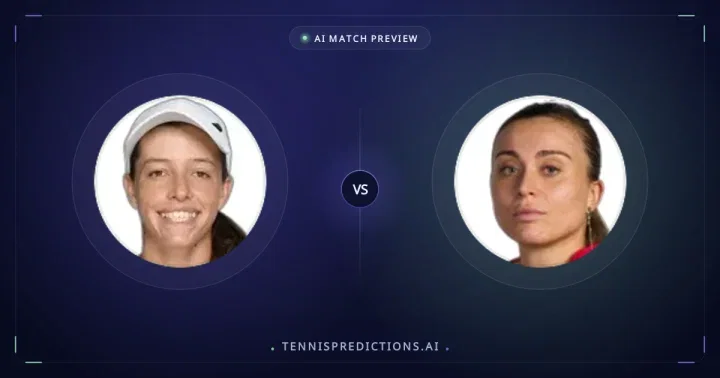
An 18-9 hard-court record gives Kaitlin Quevedo the clearest statistical edge in this match, because Paula Badosa arrives in Hong Kong with a 14-13 mark on the surface in 2026. The market nevertheless makes Badosa a firm 1.46 favorite and places Quevedo at 2.60, so the Kaitlin Quevedo vs Paula Badosa prediction starts with a direct question: does established quality outweigh the younger Spaniard’s stronger season on outdoor hard courts?
The rankings support the favorite but hardly settle the argument. Badosa is No. 61 after falling to No. 142 in June, while 20-year-old Quevedo is No. 86 after reaching a career-high No. 73 in September. Badosa’s climb of 81 places since June makes her recovery the central story, yet Quevedo’s rise has been built alongside an 18-9 hard-court season and a WTA 250 final in São Paulo. Monday’s match, scheduled for two in the morning UTC, puts those two upward curves together in the Hong Kong round of 32.
From a player’s perspective, a ranking recovery can change the way tight moments feel. Badosa acknowledged frustration with her ranking in October while also accepting why she occupied that position, and her Guangzhou wins over Carol Young Suh Lee and Sinja Kraus followed by identical 6-1, 6-4 scorelines supplied evidence of increasing control. Four sets won without requiring a tiebreak or a decider generally leave fewer emotional scars than a run full of escapes, particularly when a player is rebuilding trust in her level.
The contrast is sharp. Badosa’s Guangzhou quarterfinal ended in a 3-6, 6-2, 6-4 defeat to Harriet Dart after she had taken the opening set, so her last match before Hong Kong required her to manage a shift from front-runner to defender. When a 6-3 first set becomes a loss across three sets, the pressure often moves into the feet first: positioning can become less assertive, contact points can drift backward and the opponent gets more chances to dictate. The scoreline cannot identify every technical cause, but it does show that Badosa failed to preserve early control.
Badosa’s recovery meets Quevedo’s faster ascent
Quevedo’s recent trajectory has developed more quickly than her ranking suggests. Reaching the São Paulo final on hard courts in September helped carry her to No. 73, and beating Jil Teichmann 7-6, 6-3 in the Guangzhou quarterfinals showed that she could handle one compressed opening set before separating in the second. A 7-6 first set demands repeated service holds and point-by-point composure, while the subsequent 6-3 set indicates that the tension of the tiebreak did not drain her concentration.
Her Guangzhou semifinal presents the obvious warning. Lilli Tagger defeated Quevedo 6-2, 6-0, a score that gives underdog backers no room to pretend her floor is secure. Losing 12 of 14 games can leave a young player searching for timing and can expose how quickly a match runs away when the first two steps stop placing her in balanced positions.
Badosa’s own final Guangzhou result was less severe, but the three-set loss to Dart came one day before Quevedo’s semifinal defeat. Neither woman therefore enters Hong Kong behind an unbeaten week, and both must reset after a tournament ended with a loss. The difference lies in what preceded those exits: Badosa recorded two straight-set victories before surrendering a one-set lead, while Quevedo defeated Teichmann in straight sets before winning only two games against Tagger.
Rankings tell an incomplete story. Badosa’s return from No. 142 to No. 61 deserves respect because an 81-place climb rarely occurs without sustained results, but Quevedo’s current No. 86 position sits only 25 places behind her compatriot. A price of 1.46 implies a much stronger separation than 25 ranking places and hard-court records of 14-13 versus 18-9 appear to justify.
I disagree with the 1.40 lean toward over 18.5 games. The line is low enough to survive many straight-set scorelines, but Quevedo’s 6-2, 6-0 semifinal loss and Badosa’s pair of 6-1, 6-4 Guangzhou wins both demonstrate realistic routes to a quick match. At such a short price, the total asks bettors to accept limited upside despite recent evidence that either player can be involved in a one-sided score.
First-contact pressure can expose the favorite’s price
No professional-tour meeting exists between the two Spaniards, which matters most in the opening games. Familiarity normally helps a returner recognize serve locations and helps both players anticipate preferred patterns under pressure; without it, early adjustments can carry extra weight. Quevedo’s 7-6 opening set against Teichmann supports her ability to remain composed while those patterns develop, whereas Badosa’s 6-1 first sets against Lee and Kraus show how forcefully she can punish a slow start.
Badosa should be favored on the strength of her No. 61 ranking and her rapid climb since June, but 1.46 leaves little protection if the match becomes physically or emotionally uneven. Her 14-13 hard-court record means she has won only one more match than she has lost on the surface this season, so the price reflects reputation and recent recovery more strongly than outright dominance.
Quevedo’s case rests on more than youth or potential. Her 18 hard-court wins exceed Badosa’s total by four, her nine defeats are four fewer, and her São Paulo final demonstrates that she has already sustained a full tournament run at WTA 250 level on the surface. Those numbers do not make her the likelier winner in isolation, but they make 2.60 look more generous than the favorite’s 1.46.
Our pick is Kaitlin Quevedo to win at odds of 2.60.
Conviction is very limited despite the appealing price. Quevedo’s semifinal collapse against Tagger is too recent and too emphatic to treat the underdog as a routine value play, while Badosa’s two 6-1, 6-4 victories in Guangzhou show that her ranking rebound has translated into efficient hard-court wins. The wager is built on the mismatch between price and seasonal surface records, not on an expectation that Quevedo will control the match from the first ball.
The opening set should reveal whether Quevedo can move beyond the Tagger defeat. Her Teichmann victory provides a better template because 7-6, 6-3 combined nerve under pressure with cleaner separation afterward; another competitive first set would force Badosa to win at a level not fully reflected by a 14-13 hard-court season. If Badosa instead repeats either of her 6-1 starts from Guangzhou, Quevedo’s 2.60 will quickly look ambitious.
A place in the Hong Kong round of 16 belongs to the winner, but the more important betting tension is between Badosa’s ranking revival and Quevedo’s stronger hard-court ledger. The market has committed firmly to the comeback. The larger price sits with the player whose 18-9 record and September final make her a live outsider, even after the sharp warning delivered by her last defeat.