AI Tips for Halys vs Zverev
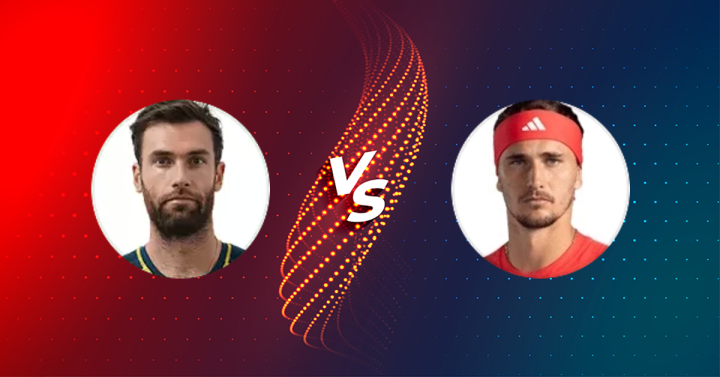
Match preview: Quentin Halys vs Alexander Zverev
The ATP Miami Open serves up a fascinating Round of 16 matchup as Quentin Halys takes on Alexander Zverev. The scheduled kick-off is set for 2026-03-25 at 00:30:00 UTC, and on paper this looks like a classic “underdog vs elite seed” contest—exactly the kind of match bettors love because the story is clear, but the details still matter.
The market is strongly tilted toward the German: Quentin Halys is priced at 6.4 to win, while Alexander Zverev sits at 1.13. That gap tells you bookmakers see Zverev as the far more likely winner, but it’s still worth understanding why Halys has made it this far and what could keep the match competitive for stretches.
If you like data-driven angles, you can also compare perspectives with Tennis Analyses, which aligns closely with the betting odds for this one.
Quick odds snapshot
Moneyline
- Quentin Halys to win: 6.4
- Alexander Zverev to win: 1.13
Total games
- Under 28.5 games: 1.27
Form guide and why this match is happening
Quentin Halys: the “serve-first” dream run
Halys has been one of the feel-good stories of the tournament. Coming in as a qualifier-turned-contender, he’s played the kind of aggressive, high-efficiency tennis that can flip a match quickly—especially on hard courts in Miami where serving and first-strike patterns can be rewarded.
What’s stood out most is how hard he’s been to break. Across his first three matches, he’s reportedly been broken only three times, which is a big deal for an underdog making a deep Masters 1000 run. Results-wise, he’s built confidence step by step:
– He recovered from a slow start to beat Liam Draxl 6-7, 6-1, 6-1.
– Then he produced a statement win over No. 16 seed Alejandro Davidovich Fokina, taking it 7-6, 6-4 in a match where holding nerve in key moments mattered.
– In round three, he backed it up with a 7-6, 6-1 win over Kamil Majchrzak, finishing stronger as the match went on.
For beginner bettors: when an underdog is winning lots of tiebreak-ish sets and protecting serve, it often means they can “hang around” even against better players—at least until the favorite starts reading the serve and extending rallies.
Alexander Zverev: elite baseline control and big-match experience
Zverev arrives with the profile bettors typically trust in the second week of a Masters event. He’s a seven-time Masters 1000 champion and has previously made a Miami final, which matters because experience in these conditions (humidity, slower hard court feel, long rallies) can become a real edge.
His recent momentum has looked solid too. After a strong semifinal run at Indian Wells, he’s carried that form into Miami:
– He opened by handling Martin Damm Jr. 6-2, 6-4 with minimal fuss.
– Then he passed a more serious test against Marin Cilic, winning 6-2, 5-7, 6-4—exactly the kind of match where top players show they can reset after losing a set.
The key takeaway: Zverev doesn’t need to play perfect tennis to win. He can win with serve placement, deep returns, and patient rally tolerance—especially against opponents who rely heavily on quick points.
Tactical matchup: what decides Halys vs Zverev?
This matchup is likely to revolve around three simple questions:
1) Can Halys keep serving at an elite level?
Halys’ path so far has been built on holding serve and landing first strikes. Against Zverev, that’s harder because Zverev’s return position and reach allow him to neutralize serves that don’t hit their spots. If Halys’ first-serve percentage dips, Zverev can start leaning into second serves and taking control early in points.
2) Who wins the “neutral rally” exchanges?
Zverev is at his best when points extend beyond the first two or three shots. If Halys can’t finish quickly, rallies tend to drift toward Zverev’s comfort zone—deep cross-court patterns, controlled aggression, and forcing the opponent to hit one extra ball.
3) Can Halys steal a set via a tiebreak?
This is the underdog’s most realistic route to making the scoreboard interesting. If Halys serves lights-out for a set, a tiebreak becomes possible. But to win the match, he’d likely need to repeat that level twice, which is a tall order against a top seed.
AI prediction and best betting tips
TennisPredictions.ai’ AI points strongly to the favorite: it suggests 2 (second player will win) as the top prediction with a confidence score of 10.0/10 and odds of 1.13. In plain English: the model expects Zverev to win most of the time in simulations, which matches the market pricing.
It also leans toward a shorter match with the total games call: Under 28.5 games at 1.27. That’s consistent with a straight-sets Zverev win or a match where one set is tight but the other is one-sided.
Best tip (simple and beginner-friendly)
Alexander Zverev to win (1.13)
If you’re new to betting, this is the “safer” option, but the odds are low—meaning the payout is small relative to the stake. It’s often used as an accumulator piece rather than a standalone bet.
Secondary tip (total games angle)
Under 28.5 games (1.27) is basically betting that we don’t get a long three-set battle with multiple tiebreaks. If Zverev wins in two sets with one comfortable set (like 6-3, 6-2) or even a 7-6, 6-3 type scoreline, the under can still land.
Final thoughts
Halys deserves real credit for the run—especially the upset over Davidovich Fokina and the way he’s protected serve. But Zverev’s combination of experience, return quality, and ability to problem-solve mid-match makes him a tough opponent to outlast. Unless Halys produces an exceptional serving performance for two full sets, the most likely outcome is Zverev advancing, with the match staying under the 28.5 games line more often than not.