
Alexander Zverev vs Cameron Norrie Prediction
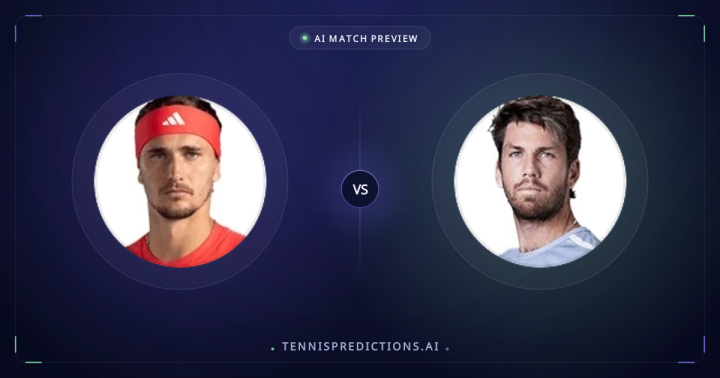
Can Cameron Norrie turn one strong set into the upset, or will Alexander Zverev again solve the left-hander over three? The Alexander Zverev vs Cameron Norrie prediction hinges on whether Norrie can sustain the serving and baseline discipline that earned him the first set in Cincinnati, because Zverev recovered there to win 3-6, 6-3, 6-3. Beijing offers the same outdoor hard-court format, with their Round of 32 match scheduled for Wednesday at three o’clock UTC.
Zverev enters as the world No. 2, the No. 1 seed and a 1.11 favorite, while Norrie is ranked No. 39 and priced at 6.50. Prices so far apart invite bettors to hunt for a hidden weakness in the favorite, but Zverev’s recent scores and the Cincinnati meeting both support the market’s hierarchy.
Three recent wins give Zverev the steadier base
Zverev has won three of his last four completed matches, and all three victories came in straight sets. His 6-2, 6-4 win over Dino Prizmic was followed by a 6-4, 7-6 victory against Matej Dodig, while a 7-6, 6-3 success over Learner Tien supplied another example of him handling a close opening set without losing control of the match. Six won sets across those three victories provide a more reliable platform than Norrie’s one win in his last four completed matches.
The footwork pattern matters on an outdoor hard court. Zverev is at his most secure when he has enough time to set his outside leg behind the ball and direct the backhand through the middle before changing direction. Norrie’s flatter backhand can disturb that setup because its lower trajectory asks Zverev to bend and create his own lift, but the 3-6, 6-3, 6-3 score in Cincinnati shows that Zverev already found a workable adjustment after losing the opening set. Once the favorite began protecting his court position over the final two sets, Norrie managed only three games in each.
Zverev’s only defeat in his latest four matches also required a narrow finish. The 2-6, 7-6, 9-11 loss to Alex de Minaur showed vulnerability in the first set, yet the second-set recovery and deciding match tiebreak kept the contest on a fine margin. A player coming directly from three wins and one close defeat should be better equipped to absorb one uneven passage than an opponent who has lost three of four.
Nerves often reveal themselves through footwork before they appear on the scoreboard. Zverev’s three recent straight-set wins suggest that his base has remained stable through important points, because two of those victories included a tiebreak and neither developed into a deciding set. His ranking also reflects the wider gap: he has moved up one place this season to No. 2 and arrives in Beijing as the leading seed.
The best-of-three format limits recovery time if Norrie starts slowly. Zverev has taken the opening set in each of his last four completed matches except the de Minaur defeat, and a lead would let him play with safer net clearance rather than chase lines.
Norrie’s Cincinnati first set maps the upset route
Norrie’s case starts with the 6-3 opening set he won against Zverev in Cincinnati on 15 August. A set by that margin cannot be dismissed as a lucky tiebreak, and it indicates that the British left-hander can make the matchup uncomfortable when he gets his forehand involved early. The left-handed serve can pull Zverev toward the doubles alley, while the next ball gives Norrie an opportunity to strike behind a taller player whose first recovery step must cover considerable space.
His 3-6, 6-1, 6-4 win over Dino Prizmic two days before meeting Zverev also demonstrates that he can reverse a match after a poor opening set. Winning the second set 6-1 required a sharp change in scoreboard pressure, and completing the turnaround 6-4 showed enough composure to protect the improvement. Norrie needs that resilient version in Beijing because merely extending neutral exchanges is unlikely to be sufficient against the No. 2 player.
Six sentences define the outsider’s tactical route. First, Norrie must serve accurately enough to stop Zverev from planting his feet on second-ball returns. Second, the forehand has to move Zverev rather than simply find the middle third of the court. Third, Norrie’s low backhand needs to remain deep, because a short ball would allow Zverev to step inside and strike from a comfortable height. Fourth, longer exchanges must include changes of direction before Zverev settles into his preferred backhand rhythm. Fifth, Norrie must preserve his court position rather than retreat as soon as Zverev adds pace. Finally, he needs to convert early scoreboard pressure, as Cincinnati became progressively less favorable once the first set had passed.
Recent results make that sequence difficult to trust for a full match. Norrie lost 2-6, 6-7 to Arthur Fils, fell 3-6, 3-6 in the last two sets against Zverev and then lost 7-6, 2-6, 2-6, 3-6 to Luca Van Assche at the US Open. Across those three defeats, the later stages were the problem: he won only six total games in the final two sets against Van Assche and six across the final two against Zverev.
Our pick would look wrong if Norrie reproduces his Cincinnati opening level for two sets while preventing Zverev from establishing return depth. At 6.50, the outsider’s price pays for that possibility, but his recent scores do not make it the likeliest path.
The 1.11 price accurately reflects the rematch gap
A quote of 1.11 offers little room for ordinary match variance, so it should never be mistaken for generous value. Even so, the favorite has won three of his latest four completed matches, occupies a ranking 37 places above Norrie and beat him in their recent Cincinnati match after adjusting from a set down. Our highest level of confidence rests on those combined indicators rather than on the ranking alone.
Our prediction is Alexander Zverev to win at odds of 1.11.
The 6.50 available about Norrie is logically connected to his 6-3 first set in Cincinnati, but one strong set carries less weight than the following 3-6, 3-6 reversal and his three defeats from four completed matches. Bettors browsing broader tennis predictions should treat Zverev’s short price as a probability play rather than a large-return opportunity.
Under 26.5 games at 1.26 is the secondary lean, since three of Zverev’s last four matches ended in straight sets and Norrie’s latest three defeats finished within four sets despite the US Open using a longer format. The under still has less appeal than the match winner because Cincinnati reached 27 games when Norrie took the opener 6-3, so another three-set contest could cross the line even if Zverev advances.
The market is demanding a routine outcome, but the evidence supports that demand. Zverev’s recent ability to close straight-set wins, combined with his successful adjustment in Cincinnati, leaves Norrie needing both an exceptional start and a level he has not maintained across his latest defeats.