
Ben Shelton vs Stefanos Tsitsipas Prediction
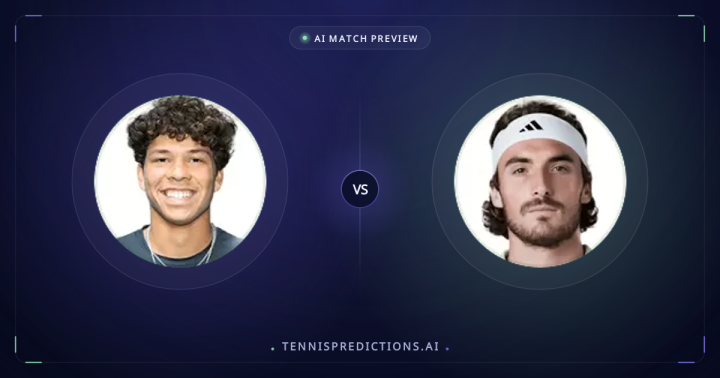
Ben Shelton carries more to lose into this fourth-round match. The No. 8 seed is ranked ninth, reached a career-high No. 6 in May and has already won hard-court titles in Dallas and Canada this season. A quarterfinal place is therefore a reasonable expectation, especially with the market making him a 1.47 favorite. Stefanos Tsitsipas, ranked No. 53 and unseeded after dropping outside the top 50 for the first time since 2018, arrives with less pressure and a potentially useful role as the 3.15 outsider.
The Ben Shelton vs Stefanos Tsitsipas prediction cannot be reduced to their current rankings. Tsitsipas has won three demanding matches in New York and owns the only previous meeting, while Shelton has needed at least four sets in every round. They are scheduled to play Monday at midnight UTC, with the winner advancing to face Carlos Alcaraz or Tommy Paul in the quarterfinals. The best-of-five format makes the price on Shelton harder to accept without examining how consistently he has controlled his service games and how Tsitsipas has responded after losing sets.
Shelton’s First Forehand Must Shorten His Service Games
Shelton’s strongest route is a familiar one: use the left-handed serve to create a weak first reply, then attack immediately with the forehand. He should have opportunities to establish that sequence against Tsitsipas, whose one-handed backhand will be the natural target when Shelton serves from the ad court. A high, forceful first ball into that side can open the next shot into the opposite corner. If Shelton repeatedly begins points on those terms, the difference between No. 9 and No. 53 may become visible.
His New York scorelines, however, show that this pattern has not made him untouchable. Shelton beat Tallon Griekspoor 1-6, 6-1, 7-6, 6-2 after being overwhelmed in the opening set. Against Hubert Hurkacz, he needed two close late sets to complete a 6-3, 5-7, 7-6(3), 7-5 win. Denis Shapovalov then took him through another tight contest before Shelton prevailed 7-6(3), 6-7(5), 6-3, 6-4.
Those three victories are substantial, but each opponent won a set and two of the matches contained multiple tiebreaks. Shelton has therefore spent much of this tournament playing without wide scoreboard margins. His serve has helped him through those moments, yet the results do not support the assumption that he will move cleanly through three sets against an experienced opponent.
The 23-year-old’s broader hard-court record is stronger than those individual struggles suggest. He is 22-12 on the surface in 2026, with the Dallas and Canada Masters titles confirming that his attacking game can hold up across complete tournaments. His 4-6, 4-6 loss to Jaime Faria in Cincinnati on August 16 was a setback, but he has answered it with three wins in New York.
Shelton also explained after beating Shapovalov that anger had fueled him before he accepted his position and concentrated on what was required to win. That response matters in a long match. He has already recovered from a 1-6 set against Griekspoor and from losing the second set against Hurkacz and Shapovalov. The concern for bettors taking 1.47 is not whether he can respond; it is how often he may be required to do so.
This first-strike pattern still favors Shelton. His ranking, seed and season record all support him when he can dictate behind serve. Yet it needs to work efficiently because extended service games would allow Tsitsipas to make the contest physical and increase the number of pressure points. Shelton is the likely winner of this particular battle, but not by enough to make his match price comfortable.
Tsitsipas Can Hold the Backhand Diagonal Long Enough
The obvious tactical instruction for Shelton is to apply pressure to the Tsitsipas backhand. That does not mean every exchange on that wing automatically belongs to the American. Tsitsipas can use the backhand crosscourt to stay in rallies, wait for a shorter ball and then look to change direction or create a forehand. His task is less about producing direct backhand winners than preventing Shelton from ending points with the next strike.
His progress through the first three rounds shows repeated success after difficult starts. Arthur Fils won the opening set before Tsitsipas recovered 4-6, 7-6(3), 6-1, 6-4. Lloyd Harris also took the first set, but Tsitsipas came back 6-7(1), 6-3, 7-6(4), 6-4. Jiri Lehecka then opened with a 6-2 set before Tsitsipas responded 6-1, 7-6(3), 6-1.
Across those matches, Tsitsipas lost each opening set but won the next three. That is a clear sign of adjustment within matches. It also means he has played enough pressured tennis to be comfortable if Shelton starts quickly. The Greek has won two tiebreaks during this run and conceded only two games in each of his final sets against Fils and Lehecka. Those scores give the outsider a stronger current case than his ranking alone implies.
Tsitsipas also leads their head-to-head 1-0. Their previous meeting came on a hard court at the Cincinnati Masters on August 16, 2023, and he won 7-6(3), 7-6(2). One match from three years ago cannot settle this one, especially given Shelton’s subsequent rise and Tsitsipas’s fall to No. 53. It does establish that Tsitsipas has already handled the American’s serve and forehand combination in two pressure sets.
The backhand lane may be where the gap between Tsitsipas’s current ranking and his actual threat is most relevant. Shelton will expect to dominate it, but he has not swept aside opponents in New York. Griekspoor, Hurkacz and Shapovalov all found a way to take a set, while Tsitsipas has repeatedly absorbed an early setback and changed the direction of the match.
Tsitsipas described his mental preparation after beating Lehecka as accepting an ancient Greek philosophy of imagining the worst-case scenario before entering the contest. The language was dramatic, but his scorelines support the practical point: falling behind has not caused him to abandon the match. That quality has particular value when the favored player’s best pattern can produce sudden runs of quick points.
This exchange does not give Tsitsipas an outright technical advantage. It gives him a survival route. If he can keep enough backhand replies deep and avoid offering Shelton routine forehands from inside the baseline, the American will have to hit additional attacking shots. Over five sets, those extra balls can turn a short favorite’s expected win into another sequence of close sets.
A Deeper Return Position Can Extend the Score
Return position is likely to determine whether this becomes a routine Shelton win or another four-set assignment. Tsitsipas needs enough space to control the pace of the left-handed serve, particularly when Shelton targets the backhand. Standing farther behind the baseline can concede court position, but it may also improve his chance of putting the ball back with height and depth rather than taking a rushed swing.
Shelton must prevent that adjustment from becoming comfortable. If Tsitsipas settles deep, the American can vary direction and use the open court rather than repeatedly serving to the same wing. He can also follow a shorter return forward, forcing Tsitsipas to pass from a defensive position. The objective is to make the Greek’s deeper stance a liability instead of allowing it to lengthen every service game.
There is a trade-off for Tsitsipas. Returning from farther back may help him begin neutral rallies, but it leaves more ground to recover after the serve. Shelton can exploit that space with his first forehand. Tsitsipas therefore does not need to win a high percentage of return points throughout the match; he needs to create a few concentrated spells of pressure in each set.
Shelton’s three tournament results indicate that such spells are possible. He has played five tiebreaks, winning three, and has dropped one set in every round. Tsitsipas has played three tiebreaks and won two. With both men accustomed to narrow sets in this tournament, the lean toward over 31.5 games at 1.30 is understandable. Four ordinary-length sets would often be enough, and all six of their completed New York matches have gone beyond straight sets.
That total is priced too short to be the main selection, but it explains why backing Shelton at 1.47 is not straightforward. The favorite can be the more likely winner while still offering limited value. Tsitsipas has already beaten him on hard court, has recovered from losing the first set in all three rounds here and is being offered at more than twice Shelton’s price.
Our confidence in the upset is very low, reflecting Shelton’s superior 2026 hard-court record and his status as a top-10 seed. Still, bettors comparing the underdog case with other today AI tennis predictions should note that Tsitsipas does not require complete control of every pattern. He needs to protect his backhand adequately, extend Shelton’s service games and keep the match close enough for his return pressure to matter.
The market is probably right to favor Shelton, but the available prices create a different betting decision from simply naming the likelier winner. Our pick is Stefanos Tsitsipas to win at odds of 3.15.