
Daniil Medvedev vs Sho Shimabukuro Prediction
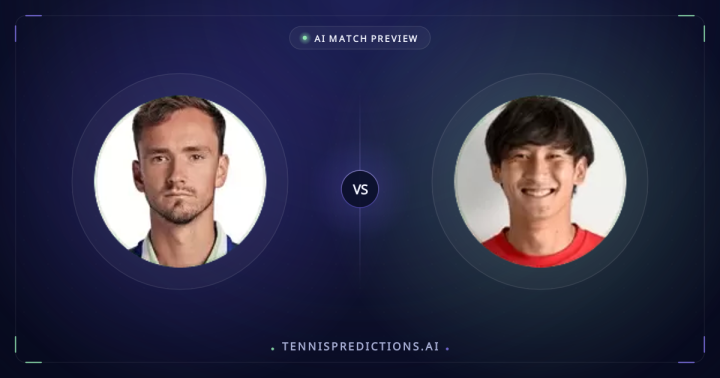
Can Sho Shimabukuro turn one Almaty win into the biggest upset of his season? The short answer is that he has earned the right to ask the question after beating Roman Safiullin in the opening round, but Daniil Medvedev’s 35-10 hard-court record makes the longer answer much less generous. Our Daniil Medvedev vs Sho Shimabukuro prediction starts with the difference between a dangerous performance and a season-long standard.
Shimabukuro is not an inexperienced newcomer despite his No. 109 ranking. The 29-year-old reached a career-high No. 87 on August 24, and his season includes a 4-6, 7-6(5), 6-4 victory over Nick Kyrgios in Stuttgart. His route into the Almaty round of 16 also carries a useful reference point: Safiullin was the player Medvedev defeated 7-5, 6-4 in the Hangzhou semifinal earlier this season. Results against a common opponent never settle a match, but beating Safiullin gives Shimabukuro something concrete to build upon rather than merely hoping the favorite starts slowly.
The assignment still changes sharply here. Medvedev is ranked No. 5, owns the top seed in Almaty and has won three ATP Tour titles this season, with Brisbane, Dubai and Hangzhou all coming on hard courts. A 35-10 record on the surface describes sustained control across many tournaments, whereas Shimabukuro’s 19-20 hard-court mark describes a player who has remained competitive without regularly controlling this level.
Shanghai leaves Medvedev one repair to make
Start with the recent sequence. Medvedev beat Tommy Paul 6-3, 1-6, 6-3 in the Shanghai quarterfinal on October 16, then lost 6-3, 6-4 to Rafael Jodar in the semifinal a day later. The defeat interrupted his run but did not erase the quarterfinal recovery against Paul, where Medvedev answered a 1-6 middle set by taking the decider 6-3.
Medvedev identified the relevant issue after the semifinal, saying Jodar “was returning well” and that he could have been better with his serving spots. For a newcomer assessing this match, the important point is not to treat every recent defeat as evidence of broad decline: a straight-sets loss tied partly to serve placement sits beside three 2026 hard-court titles and a 35-10 surface record. One afternoon in Shanghai therefore deserves attention, but it should not carry the same weight as the full season.
Here is the coaching question: what must Medvedev correct first? His own comment points to location on serve, and the 6-3, 6-4 score against Jodar shows the problem did not produce a collapse or a deciding-set marathon. Better placement would reduce the number of neutral starts Shimabukuro receives, which matters because the underdog’s best wins this season have come when he has stayed close enough to reverse pressure: the Kyrgios victory required a 7-6(5) second set before a 6-4 decider.
Shimabukuro has also shown he can dispatch a lower-pressure assignment efficiently, beating Hugo Dellien 6-3, 6-1 in Cincinnati qualifying. Yet his latest Shanghai appearance ended in a 6-2, 6-4 loss to Miomir Kecmanovic on October 7, so his October results contain both an early exit and the Almaty win over Safiullin. A bettor should resist turning either result into his entire profile.
There is no tour-level meeting to consult. In practical terms, that removes one familiar shortcut: neither a previous upset nor a history of comfortable Medvedev wins can anchor the price. The assessment instead rests on Medvedev’s year-long hard-court output, Shimabukuro’s uneven 19-20 record and the amount of resistance the underdog can produce before the favorite establishes control.
Shimabukuro’s breakthrough must survive a higher standard
The ranking gap is 104 places. Rankings alone cannot explain odds of 1.08 and 8.70, but Medvedev’s No. 5 position is backed by three hard-court trophies, while Shimabukuro’s No. 109 position accompanies one more hard-court loss than win in 2026. The market is not asking whether Shimabukuro can play a good set; his comeback against Kyrgios already answers that. It is asking whether he can sustain the level required to beat the season’s top Almaty seed over two or three sets.
Keep the route simple. Shimabukuro needs to protect his opening service games and avoid allowing the favorite to turn the first set into a score such as the 6-2 opener Kecmanovic produced in Shanghai. Medvedev, meanwhile, does not need a spectacular start if he serves with better placement than he described after the Jodar loss; his 6-3 deciding set against Paul shows he can regain authority after losing momentum.
Thursday’s match begins at seven-thirty UTC, with a quarterfinal place awaiting the winner. Indoor hard conditions remove weather from the equation, leaving the match to be judged through the players’ hard-court records and recent scorelines rather than speculation about wind or heat.
The prices make the decision uncomfortable. Medvedev at 1.08 offers little return for accepting even ordinary best-of-three volatility, and our conviction sits just below the midpoint despite the large gap in ranking and seasonal performance. Shimabukuro at 8.70 is substantial, but a big price is not automatically value when it is attached to a 19-20 hard-court record against an opponent who has gone 35-10.
Our pick is Daniil Medvedev to win at odds of 1.08.
I disagree with the under 24.5-games lean at 1.28. Shimabukuro’s 4-6, 7-6(5), 6-4 win over Kyrgios demonstrates a credible route to extending a match, while Medvedev’s last two Shanghai rounds included a three-set win over Paul and a semifinal defeat, making such a short total price too restrictive.
Backing Medvedev is therefore a judgment about who advances, not a promise that every set will be routine. Shimabukuro has already removed Safiullin and has previously recovered from a set down against Kyrgios, so his route is to keep the first set close enough for pressure to reach the favorite’s 1.08 price. Medvedev’s answer lies in the broader record: 35 hard-court wins, three titles on the surface and the ability to close Paul 6-3 after a difficult middle set.
The key distinction is repeatability. Shimabukuro has individual results capable of troubling a highly ranked opponent, but Medvedev has reproduced winning hard-court tennis across Brisbane, Dubai, Hangzhou and Shanghai. If the top seed corrects the serve-location issue he identified after facing Jodar, Shimabukuro will need more than the confidence of his Safiullin victory; he will need his strongest level to hold through the entire best-of-three contest.