
Leylah Fernandez vs Talia Gibson Prediction
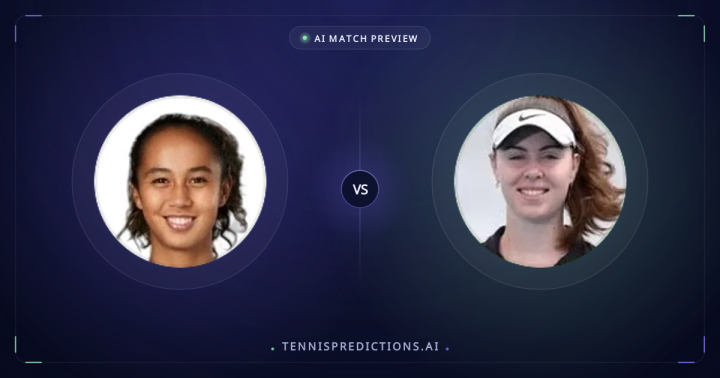
Leylah Fernandez’s 6-2, 7-5 quarterfinal win over No. 1 seed Mirra Andreeva is the scoreline that tells me most about this final. Beating the tournament’s leading seed in two sets gives the world No. 31 the strongest result either player has produced in Singapore, and it anchors my Leylah Fernandez vs Talia Gibson prediction more firmly than either ranking alone.
Gibson’s rise deserves respect, not sentimentality. The 22-year-old began 2026 at No. 118 and arrives in her first WTA Tour-level singles final at No. 63, with a victory projected to carry her into the top 40 for the first time. Fernandez, meanwhile, is the No. 6 seed at age 24 and can collect her sixth WTA singles title by winning Sunday at ten o’clock UTC.
The contrast is clear.
Fernandez has already closed five tour-level championship runs, while Gibson is entering this setting for the first time. Experience does not automatically settle a best-of-three hardcourt final, but the market has made it part of the calculation: Fernandez is 1.47, and Gibson is 2.80.
Gibson’s rapid rise reaches unfamiliar ground
Gibson has not stumbled into the final. Her 7-6(2), 7-6(1) win over Viktoria Morvayova in the round of 16 required her to settle two sets through tiebreaks, and her 6-1, 4-6, 6-2 quarterfinal victory over No. 7 seed Maria Sakkari showed she could recover after losing the second set.
Still, her route changed sharply in the semifinal. Gibson advanced through a walkover after Tatiana Prozorova withdrew because of a concussion sustained in a doubles match, so the Australian enters the final without having played a semifinal point.
I would not automatically call the walkover an advantage. Gibson avoided the physical cost of another match, but her last completed contest was the three-set win over Sakkari, whereas Fernandez had to solve a difficult semifinal less than a day before the title match. With no previous WTA Tour meetings between them, there is no direct evidence showing whether rest or recent competitive rhythm will matter more.
Gibson’s own reaction after the quarterfinal also fits the scale of her week. “I didn’t expect to get this far this week, so I think I just really enjoy the moment and enjoy being where I’m at,” she said after reaching the last four. A player who has climbed 55 ranking positions since the start of the season has earned the right to enjoy it, but bettors should separate a breakthrough story from the probability attached to 2.80.
Gibson is still dangerous.
Her Sakkari win is the clearest reason not to treat Fernandez’s price as a formality: a 6-1 opening set and a 6-2 deciding set against the No. 7 seed represent two emphatic passages around the lost middle set. Her two tiebreak wins against Morvayova also show that both completed matches in Singapore demanded something different from her.
I trust Fernandez’s 6-2, 7-5 win over top seed Andreeva more, and I trust Gibson’s semifinal advancement less because it came by walkover rather than through a completed match. That is not criticism of Gibson; it is simply the distinction I would use when pricing the final.
Fernandez has already answered the harder questions
Fernandez’s semifinal was not smooth, and that matters. Maja Chwalinska took the opening set 6-1, but Fernandez recovered to win 6-4, 6-2, turning a one-sided start into a three-set victory. The comeback adds physical workload, yet the final two sets provide a relevant example of Fernandez correcting a match that had moved heavily against her.
No shortcut was available.
Her comments after the semifinal underline how awkward that assignment had been. Fernandez described Chwalinska as “very tricky to play against” and said, “She doesn’t give you the same ball twice, not even three times.” The 1-6, 6-4, 6-2 score supports the idea that Fernandez needed time to find solutions, while the closing set suggests she eventually found enough of them.
The Andreeva result remains the cleaner reference. Fernandez won 12 of 19 games in a 6-2, 7-5 victory over the No. 1 seed, and she did so without allowing the match to reach a deciding set. Put beside Gibson’s 6-1, 4-6, 6-2 defeat of Sakkari, the favorite owns the better win against the higher-seeded opponent.
Fernandez also has a concrete historical target: victory would give her a sixth career WTA singles championship and her first title of 2026, following her most recent trophy at the 2025 Japan Open. Gibson’s target is different but equally measurable, with 500 ranking points, $185,500 and a projected first appearance in the top 40 attached to a win.
Pressure cannot be priced precisely from those incentives, so I would not build a bet around assumptions about nerves. Gibson’s first final may free her to play without established expectations, or the new setting may make important games harder to close. Nobody knows which version appears before the first ball.
The price is more useful. Fernandez at 1.47 implies a clear but not overwhelming edge, which feels appropriate when the No. 31 has beaten Andreeva in straight sets and recovered from 1-6 down against Chwalinska, while the No. 63 has beaten Sakkari but did not contest a semifinal.
Readers comparing the day’s AI Tennis Predictions should note that our conviction here is modest rather than forceful, sitting just below the midpoint of the scale. A 1.47 favorite can lose often enough to make aggressive staking a poor idea, particularly against an opponent whose ranking has climbed from No. 118 to No. 63 this season.
Our pick is Leylah Fernandez to win at 1.47.
I would keep the stake controlled. Fernandez’s superior ranking, five previous WTA singles titles and victory over the top seed all support her position as favorite, but Gibson’s Sakkari win is too substantial to justify treating 1.47 as an easy short-price selection.
The under 26.5 games at 1.39 is the secondary lean, though I like it less as a standalone wager because several plausible score patterns can threaten it. Gibson has already played two tiebreaks in one match, Fernandez needed three sets in the semifinal, and Gibson’s quarterfinal also went the distance.
There is still a numerical case for the under: Fernandez’s quarterfinal finished in 20 games, while Gibson’s quarterfinal contained 25 despite reaching three sets. A routine straight-set win for either player would probably stay below 26.5, and even a compact three-set contest can do so, as Gibson’s 6-1, 4-6, 6-2 score demonstrated with 25 games.
The margin remains thin.
For me, the cleaner position stays with the match winner rather than the total. Fernandez has completed both a straight-set dismissal of the No. 1 seed and a three-set comeback this week, giving the 1.47 favorite two distinct winning routes already established in Singapore. Gibson’s breakthrough has been real, but 2.80 asks bettors to believe her first completed match since the Sakkari quarterfinal will also become her first tour-level title.