
Daria Kasatkina vs Anna Kalinskaya Prediction
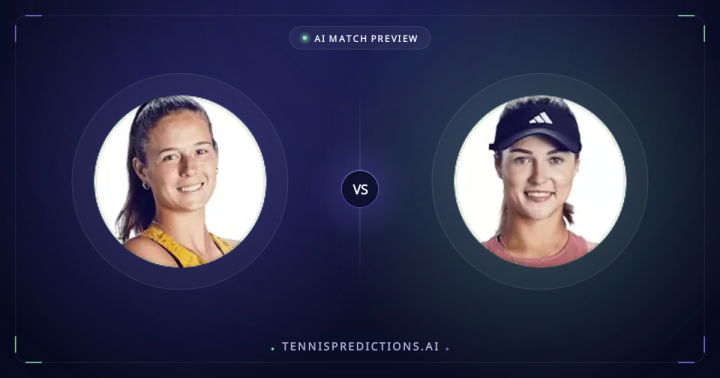
Kasatkina vs Kalinskaya Prediction, Betting Tips and Match Preview
The WTA Washington, USA event brings us a very intriguing Round of 32 meeting as Daria Kasatkina faces Anna Kalinskaya on 2026-07-28 at 16:00:00 UTC. This is the kind of first-round match that immediately catches the eye of bettors because it combines name value, contrasting styles, and a market that appears to lean clearly toward one side.
According to the available betting odds, Daria Kasatkina is priced at 2.55, while the opposite side of the market is listed at 1.61. The AI prediction from TennisPredictions.ai selects 2, meaning Anna Kalinskaya to win, with a very strong confidence score of 9.3/10 and odds of 1.61. The total games market also offers an interesting angle, with the prediction landing on Over 17.5 games at odds of 1.32.
Best Tip: Anna Kalinskaya to win at 1.61
This preview breaks down the matchup from a betting perspective, looking at playing styles, tactical patterns, market value, expected match flow, and why the AI model is siding with the second player. The goal is not just to identify a pick, but to explain whether the odds make sense and how bettors should approach this WTA Washington clash.
Match Overview: WTA Washington Round of 32
The Mubadala Citi DC Open in Washington, D.C. has become an important stop on the North American hard-court swing. As a WTA 500 event, it attracts a strong field and often produces high-quality early-round matches. This opening-round clash between Kasatkina and Kalinskaya is a perfect example: two experienced Russian-born players with established tour-level credentials, but with very different tennis identities.
Kasatkina is one of the most creative players on the WTA Tour. She does not rely on overwhelming power. Instead, she builds points through variation, spin, angles, slices, changes of height, and sharp court awareness. When she is reading the game well, she can make even powerful opponents look uncomfortable.
Kalinskaya, by contrast, is generally the more direct player. She has a cleaner first-strike game, flatter timing from the baseline, and the ability to take the ball early. On hard courts, that profile can be extremely effective, especially when conditions reward aggressive positioning and quick transitions from defense to attack.
That difference in style is what makes this matchup so appealing from a betting angle. Kasatkina will want rhythm disruption. Kalinskaya will want court control. Kasatkina will try to extend rallies, open angles, and force uncomfortable contact points. Kalinskaya will try to step inside the baseline, pressure the second serve, and keep points from becoming too tactical.
Betting Odds and Market Interpretation
The listed price of 2.55 on Kasatkina indicates she is the underdog in this matchup. The shorter price of 1.61 corresponds with the AI-backed side, Anna Kalinskaya. For betting purposes, this suggests the market sees Kalinskaya as the more likely winner, and TennisPredictions.ai agrees strongly with that view.
A confidence rating of 9.3/10 is notable. In tennis betting, high-confidence moneyline selections are usually driven by several combined factors: recent form, surface suitability, head-to-head dynamics, fitness indicators, serve and return metrics, and matchup compatibility. While no model can guarantee an outcome, such a strong rating tells us the AI sees a clear edge for Kalinskaya.
At 1.61, the implied probability is roughly 62.1%. That means the market is asking bettors to believe Kalinskaya wins this match more than six times out of ten. If the AI confidence is accurate, there may still be value at that number, especially if Kalinskaya’s aggressive hard-court game is expected to neutralize Kasatkina’s craft.
Meanwhile, the Over 17.5 games line at 1.32 is a lower-risk, lower-return angle. It suggests the match is expected to be competitive enough to clear a modest total. In WTA best-of-three tennis, Over 17.5 games can cash in many common scorelines, including 6-4 6-4, 6-3 6-4, 7-5 6-3, or any three-set match. Given the quality of both players, this total is very achievable unless one player completely dominates.
Daria Kasatkina Player Profile
Daria Kasatkina is one of the most tactically intelligent players on the women’s tour. Her game is built around variety rather than raw force. She uses topspin, changes of pace, drop shots, looping forehands, backhand angles, and clever defensive positioning to test an opponent’s patience.
Kasatkina’s greatest strength is her tennis IQ. She reads patterns early and often forces opponents to hit one extra ball. Against players who are inconsistent or impatient, this can be devastating. Instead of giving pace, she absorbs it and redirects it. Instead of trading power for power, she asks questions.
That is why Kasatkina is often dangerous as an underdog. If an opponent loses focus, overhits, or becomes frustrated, she can turn the match into a tactical battle. She has the skill set to break rhythm and create uncertainty. In betting terms, she is not a player bettors should dismiss simply because she is priced at 2.55.
However, the challenge for Kasatkina on hard courts is that her serve can be attacked. She is not typically a dominant server, and when her first-serve percentage drops, opponents can step in and pressure her second delivery. Against a confident ball-striker like Kalinskaya, that is a significant concern.
Kasatkina also needs time to construct points. If Kalinskaya consistently takes the ball early and controls the center of the court, Kasatkina may find herself defending too often. Her defensive skills are excellent, but if she spends too much of the match behind the baseline, it becomes difficult to dictate.
Anna Kalinskaya Player Profile
Anna Kalinskaya has developed into a dangerous hard-court player because of her clean ball-striking and ability to apply pressure from the baseline. She is more aggressive than Kasatkina and generally looks to shorten points when she has the opportunity.
Kalinskaya’s game is well suited to medium-to-fast hard courts. She can redirect pace effectively, attack second serves, and use flatter groundstrokes to rush opponents. When her timing is sharp, she can take away the time that tactical players like Kasatkina need to build rallies.
One of the most important factors in this matchup is Kalinskaya’s return game. If she is aggressive on Kasatkina’s second serve, she can immediately put Kasatkina under pressure. That can create a snowball effect: Kasatkina may feel the need to be more precise on serve, which can lead to double faults or lower first-serve percentages.
Kalinskaya also has the advantage of being able to win more cheap points. She may not be a pure power player in the mold of the biggest hitters on tour, but compared with Kasatkina, she has more direct finishing ability from neutral positions. On a hard court, that matters.
The risk with Kalinskaya is execution. Aggressive players must manage errors. If she becomes too impatient or allows Kasatkina to stretch points into awkward patterns, the match can become complicated. But if Kalinskaya maintains discipline, uses controlled aggression, and chooses the right moments to attack, the matchup looks favorable.
Tactical Matchup: Why Kalinskaya Has the Edge
The main tactical question is whether Kasatkina can disrupt Kalinskaya’s timing often enough. Kasatkina will likely use height, spin, slices, and angles to stop Kalinskaya from settling into clean baseline rhythm. She may also try to draw Kalinskaya forward with drop shots or short slices, forcing her to hit on the move.
Kalinskaya’s best response is to stay proactive without becoming reckless. She does not need to hit winners from every position. She simply needs to take time away, pressure the Kasatkina serve, and step inside the court when the opportunity appears.
The matchup favors Kalinskaya if rallies begin on her terms. That means strong returns, early depth, and consistent pressure into Kasatkina’s forehand and movement patterns. If Kalinskaya can pin Kasatkina deep, she can prevent her from using the full variety of her game.
Kasatkina’s best route is to make the match uncomfortable. She needs to extend rallies, create unusual ball shapes, and tempt Kalinskaya into overpressing. She also needs to serve intelligently, not necessarily with speed, but with placement. Body serves, wide angles, and changes of direction can help her avoid predictable second-serve situations.
Still, over a full match, Kalinskaya’s ability to control the baseline looks like the more reliable weapon on this surface. That is likely why the AI model strongly favors the second player.
Washington Conditions and Surface Impact
Washington is part of the North American summer hard-court swing, and conditions can be demanding. Heat, humidity, and outdoor variables often play a role. Balls can fly during warmer parts of the day, and players must manage physical and mental energy carefully.
For Kalinskaya, quicker hard-court conditions can enhance her offensive game. If the court rewards early ball-striking, she can take time away from Kasatkina and prevent long tactical exchanges. Her ability to redirect pace and flatten out groundstrokes should be useful.
For Kasatkina, outdoor conditions can be a mixed factor. Wind or variable bounce can help her because she is comfortable with unconventional rallies and changes of rhythm. However, if the ball travels quickly through the court, her defensive retrieving becomes more difficult.
At 16:00 UTC, the match timing may involve warm conditions depending on the local schedule and court assignment. Fitness and point construction will matter. Kasatkina may benefit from extended rallies, but Kalinskaya may benefit if the heat rewards shorter, more aggressive point patterns.
AI Prediction Analysis
TennisPredictions.ai selects 2, meaning Anna Kalinskaya to win, with a confidence score of 9.3/10. That is a strong endorsement and aligns with the market price of 1.61.
From a betting expert’s perspective, this is not just a simple favorite pick. The reasoning appears rooted in matchup logic. Kalinskaya has the kind of hard-court weapons that can trouble Kasatkina: aggressive return positioning, clean baseline timing, and the capacity to finish points before Kasatkina can fully impose her variety.
Kasatkina is always capable of making a match tricky, but the AI appears to rate Kalinskaya’s win probability significantly higher. That may reflect current performance trends, surface compatibility, or stylistic advantage.
The important question for bettors is whether 1.61 is still playable. In many cases, odds below 1.70 can feel short in WTA matches because momentum swings and service breaks are common. However, if the confidence rating is as high as 9.3/10, and if the matchup supports the favorite, then 1.61 can be justified as a main bet.
Main Betting Tip: Anna Kalinskaya to Win
Best Tip: Anna Kalinskaya to win at 1.61
Kalinskaya is the recommended moneyline selection. She enters this betting preview as the player with the stronger projected edge due to her ability to dictate on hard courts and pressure Kasatkina’s serve.
The biggest advantage for Kalinskaya is her capacity to control first-strike patterns. If she wins enough return points and avoids long stretches of unforced errors, she should be able to keep Kasatkina under sustained scoreboard pressure. That is crucial because Kasatkina is at her best when she can play freely, vary tempo, and turn matches into problem-solving contests.
At 1.61, Kalinskaya is not a huge favorite, but she is clearly the more trusted side. The price is suitable for bettors who prefer a relatively straightforward moneyline angle rather than chasing higher-risk set betting or handicap options.
Kasatkina’s underdog odds of 2.55 may attract some bettors because of her experience and tactical versatility. However, the matchup points toward Kalinskaya having the more reliable route to victory. Unless Kasatkina serves exceptionally well and successfully disrupts rhythm from the first few games, Kalinskaya should have the upper hand.
Total Games Prediction: Over 17.5 Games
The AI-supported total games prediction is Over 17.5 at odds of 1.32. This is a conservative but logical market.
Over 17.5 games does not require a marathon. A straight-sets result can still cash comfortably. For example, a 6-4 6-4 Kalinskaya win totals 20 games. A 6-3 6-4 result totals 19 games. Even a competitive 7-5 6-2 lands at 20 games.
The danger is a one-sided scoreline such as 6-2 6-2 or 6-1 6-3. While possible, it does not appear to be the most likely outcome given Kasatkina’s defensive skills and experience. Even when she is not dominating, Kasatkina often finds ways to stay in sets, extend rallies, and force opponents to earn games.
Kalinskaya may be the better pick to win, but Kasatkina is not an easy opponent to blow off the court. Her variety and resilience should help her collect enough games to push the total over this modest line.
For bettors seeking a safer companion to the moneyline, Over 17.5 games is reasonable. It can also work well in bet builders where available, though combining correlated tennis markets should always be done carefully.
Possible Score Prediction
A realistic scoreline is Anna Kalinskaya winning in straight sets, but with at least one competitive set. Something like 6-4 6-4 or 7-5 6-3 fits the overall match projection.
Kasatkina is likely to create difficult service games for Kalinskaya at times. Her return skills and point construction should allow her to generate break chances. However, Kalinskaya’s more aggressive baseline profile should give her the edge in the key moments.
Predicted score: Anna Kalinskaya to win 6-4, 6-4.
This score also supports the Over 17.5 games prediction.
Key Factors for Bettors
1. Kalinskaya’s Return Pressure
If Kalinskaya attacks Kasatkina’s second serve effectively, she can control the match. Kasatkina must avoid too many vulnerable second-serve points, because Kalinskaya can step in and immediately take command.
2. Kasatkina’s Variety
Kasatkina’s best weapon is unpredictability. If she can vary height, spin, and pace, she may force Kalinskaya into uncomfortable errors. This is the main reason the underdog cannot be ignored.
3. First-Strike Tennis
Kalinskaya should aim to win the first three shots of the rally. If she does, the favorite’s price becomes easier to justify. If rallies regularly extend beyond eight or nine shots, Kasatkina’s chances improve.
4. Mental Discipline
Against Kasatkina, patience matters. Kalinskaya must avoid trying to end points too early. Controlled aggression is the ideal approach.
5. Total Games Cushion
Over 17.5 is attractive because it allows for several common straight-set scorelines. Bettors do not need a three-set match for this pick to land.
Risk Assessment
No tennis bet is risk-free, especially in WTA matches where momentum can shift quickly. Kasatkina’s style naturally creates uncertainty because she can disrupt patterns and make opponents play below their comfort level. If Kalinskaya becomes frustrated, the match could tighten.
There is also the possibility that Kasatkina’s defensive skills force Kalinskaya into longer rallies than expected. If Kalinskaya’s unforced error count climbs, the favorite could be vulnerable.
Still, the risk is balanced by the odds and the AI confidence level. Kalinskaya at 1.61 is not a massive price, but it reflects a solid favorite rather than an overwhelming one. The market seems fair, and the AI’s 9.3/10 rating gives additional support.
For staking, a moderate approach is sensible. Kalinskaya moneyline can be treated as the primary bet, while Over 17.5 games is a lower-odds secondary selection.
Final Verdict
This WTA Washington Round of 32 match has all the ingredients of a compelling betting contest. Daria Kasatkina brings creativity, experience, and tactical intelligence. Anna Kalinskaya brings cleaner hard-court aggression, stronger first-strike potential, and the ability to pressure Kasatkina’s serve.
The AI prediction strongly supports Kalinskaya, selecting the second player to win with a confidence score of 9.3/10. From a tactical and betting perspective, that makes sense. Kalinskaya’s game should translate well to the Washington hard courts, and her ability to take time away from Kasatkina could be the decisive factor.
Kasatkina may keep the match competitive, which is why Over 17.5 games is also a strong supporting angle. However, when it comes to the winner, Kalinskaya looks like the more reliable choice.
Best Tip: Anna Kalinskaya to win at 1.61
Secondary tip: Over 17.5 total games at 1.32.
Expected outcome: Anna Kalinskaya wins in two competitive sets.