
Stefanos Tsitsipas vs James Duckworth Prediction
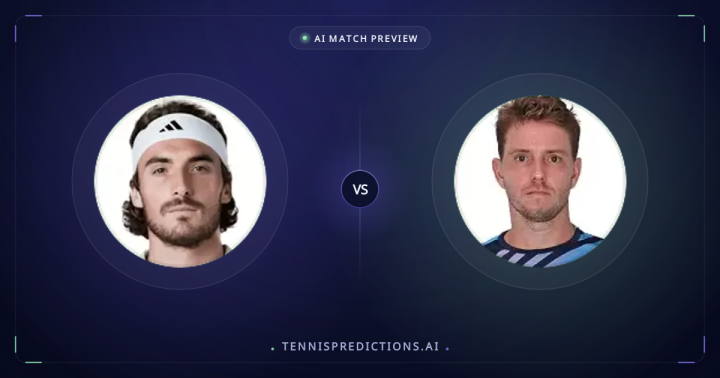
The 6-1, 6-2 scoreline Stefanos Tsitsipas produced against Mikhail Kukushkin is the most revealing number before this quarterfinal. Kukushkin won only three games, so Tsitsipas reached the last eight without the physical strain or emotional turbulence that often follows a tight indoor match.
Our Stefanos Tsitsipas vs James Duckworth prediction also has to account for an opponent who has not dropped a set in Almaty. Duckworth beat Miomir Kecmanovic 6-4, 6-3 before edging Luciano Darderi 7-5, 7-6(7), and those four sets show that the Australian has handled the important points well enough to earn his semifinal opportunity. Friday’s match begins at half past seven UTC, with Tsitsipas priced at 1.25 and Duckworth at 4.00.
Three lost games give Tsitsipas the fresher platform
A 6-1, 6-2 win allows a player to leave the court with more than a place in the next round. Tsitsipas avoided a third set, protected his energy and spent very little time dealing with scoreboard pressure against Kukushkin. In an indoor quarterfinal, where reactions and the first step can decide whether a return is struck from the baseline or behind it, such an efficient passage has practical value.
Tsitsipas also entered Almaty with recent evidence that he could solve a much more complicated match. His 3-6, 7-5, 6-3 victory over Taylor Fritz in Shanghai on 12 October required him to recover after losing the opening set, and the final two scores show that he stayed close before taking control. Two days later, Daniil Medvedev stopped him 6-4, 7-5, but even that defeat was settled by narrow set margins rather than a collapse.
The sequence matters because Tsitsipas has encountered both possible versions of a quarterfinal in the space of ten days. He has survived a three-set match against Fritz after falling behind, and he has swept Kukushkin while conceding three games. A player carrying those two recent experiences can approach the opening exchanges without treating an early service hold by Duckworth as a crisis.
From a player’s side of the court, the footwork test begins after the serve rather than during it. Duckworth’s 7-5, 7-6(7) win over Darderi says that he can keep sets compressed, which places a premium on Tsitsipas completing his first recovery step quickly and arriving balanced for the next ball. Tsitsipas does not need to force the pace immediately when his 6-1, 6-2 result has already shown he can build a wide scoreboard margin indoors. Duckworth, by contrast, has played one set to 7-5 and another to a tiebreak in his latest round, so his route has depended more heavily on late-set execution. Pressure feels different at 5-5 than it does at 2-2 because one loose service game can decide the set before there is time to repair it. Tsitsipas has the stronger recent example of escaping genuine trouble because the Fritz match turned from 3-6 into 7-5, 6-3. Duckworth has the stronger Almaty example of protecting a narrow margin because he took the Darderi tiebreak 9-7. Each pattern is useful, but Tsitsipas has demonstrated the broader range of responses.
The 2026 season records strengthen that distinction. Tsitsipas stands at 34-22, while Duckworth is 12-20 on the ATP Tour, giving the Greek 22 more victories and a winning record against an opponent who remains eight matches below .500.
The rankings understate one man’s season-long edge
Tsitsipas is currently ranked 39 after being as low as 75 in May, while Duckworth has risen to 64 from 86 in February. Both have moved in the right direction, yet a comparison of their rankings alone makes the matchup look closer than their season records suggest.
The 25-place ranking separation is meaningful, but the 34-22 against 12-20 split carries more weight for this particular price. Tsitsipas has won roughly 61 percent of his 56 matches in 2026, whereas Duckworth has won 37.5 percent of his 32 ATP Tour matches. Those rates come from different totals, but they create a substantial gap in repeatable match completion over the season.
Duckworth’s rise from No. 86 to No. 64 still deserves respect because a 22-place improvement cannot be dismissed as one good afternoon. His two Almaty wins support that movement: Kecmanovic was beaten without a tiebreak, and Darderi was held off when the second set reached 7-6(7). The difficulty for the underdog is that Tsitsipas has climbed 36 places from No. 75 to No. 39 while compiling 34 victories, so his ranking recovery comes with a much larger body of winning results.
Their sole previous meeting provides another relevant number, even though it took place more than eight years ago. Tsitsipas won 6-3, 6-4 on an outdoor hard court in Washington on 2 August 2018, establishing a 1-0 head-to-head lead without needing a deciding set. The age of the result limits how heavily it should be weighted, but its surface and score still leave Duckworth without a prior tactical success to revisit.
Duckworth is now 34 and Tsitsipas is 28, yet age itself is less useful than the scores immediately in front of us. The Australian has already shown enough control to win four straight sets this week, while the Greek has combined a comeback over Fritz with a nine-game demolition of Kukushkin. Readers comparing similarly priced favorites in our AI tennis analysis articles should distinguish between reputation and current numerical support; here, the 34-22 record and 6-1, 6-2 Almaty start support the favorite independently of his name.
The short price rests on more than reputation
Odds of 1.25 imply that Tsitsipas is expected to win four times in every five before the bookmaker’s margin is considered. The price leaves little room for error, but his 22-win advantage in the season totals, 25-place ranking lead and 1-0 head-to-head record all point in the same direction.
The strongest argument for Duckworth at 4.00 comes from how he has managed the ends of sets in Almaty. His 6-4, 6-3 win over Kecmanovic required no extended set, while the 7-5, 7-6(7) victory over Darderi showed he could function with the score tightened around him. An underdog who reaches 5-5 or a tiebreak has reduced a match to a smaller sample of points, and smaller samples can amplify one excellent return or one nervous second serve.
Nerves are not an abstract concern at this stage because victory puts the winner into the Almaty semifinals. Duckworth’s 9-7 tiebreak against Darderi shows he has already negotiated a set in which every point near the finish carried immediate consequences. Tsitsipas faced a different form of strain against Fritz, where losing the first set 6-3 forced him to play two complete sets without another lapse.
I disagree with the under 30.5-games lean at 1.26. Duckworth’s 7-5, 7-6(7) round of 16 and Tsitsipas’s three-set recovery against Fritz make such a short total price less attractive than the match winner.
The disagreement is about the wager, not necessarily the likeliest set count. A routine Tsitsipas victory such as 6-4, 6-3 would finish comfortably below 30.5, as would a repeat of his 6-3, 6-4 Washington win. The problem is that an under bet can be put under severe pressure by one 7-6 set and a competitive second set, while the Tsitsipas moneyline can survive both a tiebreak loss and an untidy opening hour.
At 1.25, the favorite’s price is not designed for bettors seeking a large single-match return. It is instead a judgment that Duckworth’s four straight sets in Almaty do not outweigh Tsitsipas’s superior season record, higher ranking and dominant opening performance. Our confidence is exceptionally strong because every major comparison favors Tsitsipas, while Duckworth’s clearest route relies on keeping the margins narrow until late in each set.
Our pick is Stefanos Tsitsipas to win at odds of 1.25.
Duckworth can make the favorite work if he reproduces the late-set composure behind his 7-5, 7-6(7) win, but Tsitsipas enters with more ways to recover when the first pattern fails. His 3-6, 7-5, 6-3 turnaround against Fritz supplies the clearest evidence: one lost set did not prevent him from finding a route through the match.