
Jakub Menšik vs Ben Shelton Prediction & Betting Tips
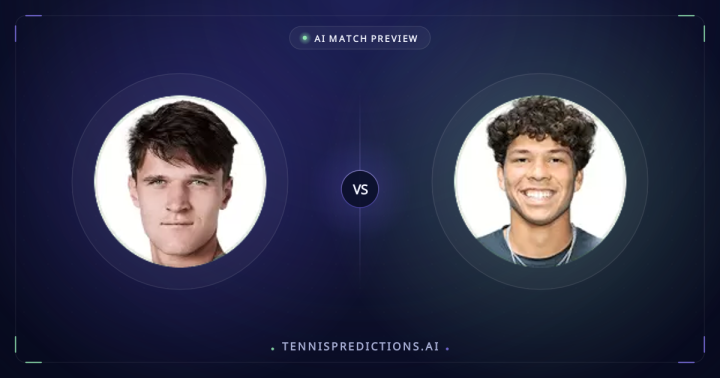
Jakub Menšík vs Ben Shelton Prediction: ATP Montreal Quarterfinal Betting Preview
Jakub Menšík and Ben Shelton are set for one of the most intriguing quarterfinal matchups at the 2026 National Bank Open in Montreal, an ATP Masters 1000 event that regularly rewards aggressive first-strike tennis, strong serving, and the ability to handle pressure in short scoring windows. The match is scheduled for 2026-08-11 at 21:00:00 UTC, and from a tennis betting perspective, it brings together two of the most exciting young power players on the ATP Tour.
This is exactly the type of contest that attracts attention from bettors looking for ATP Montreal predictions, tennis tips, AI tennis predictions, and value betting angles. Both players are associated with big weapons, fast development curves, and high-ceiling performances. However, the market and model-based indicators point slightly toward Ben Shelton as the more likely winner.
The available betting odds list Jakub Menšík at 2.10 to win, while the 1.84 price refers to the second player, Ben Shelton, being favored. TennisPredictions.ai’s AI model also suggests “2” as the top prediction, meaning Shelton to win, with odds of 1.84 and a confidence score of 2.9/10. That low confidence rating is important: it does not indicate a lock, but rather a narrow edge in a matchup where margins may be slim.
For the total games market, the highlighted line is Under 31.5 games at odds of 1.26. In simple terms, the model expects the match to stay below a very high total, even though both players are capable of serving dominant games and producing tiebreak sets.
For more data-driven previews and broader coverage of modern betting models, readers can follow AI tennis news for additional tennis betting insights.
Match Context: National Bank Open Quarterfinal
The National Bank Open in Montreal is one of the most important hard-court tournaments before the US Open. As an ATP Masters 1000 event, it attracts elite-level competition and often acts as a form guide for the North American hard-court swing. Players who perform well in Canada usually arrive at the Cincinnati Masters and US Open with confidence, rhythm, and ranking momentum.
A quarterfinal spot at this level is not just another round. It suggests both Menšík and Shelton have already handled quality opposition during the week and adapted well to the conditions. Montreal hard courts can reward players who take control early in rallies, but they also punish erratic shot selection. The ball can move quickly through the court, yet there is enough bounce for athletic defenders and heavy hitters to create angles.
That makes the matchup fascinating. Menšík is a tall, powerful Czech player with a clean baseline game, a strong first serve, and a composed tactical profile for his age. Shelton, the American left-hander, brings explosive athleticism, one of the most dangerous serves on tour, and a natural ability to lift the tempo in high-pressure moments.
This is not a classic counterpuncher-versus-attacker match. It is more of a power-versus-power battle, with the winner likely being the player who manages risk better, wins more cheap points behind the first serve, and protects second-serve points under pressure.
Odds Breakdown and Market Reading
The betting market prices Jakub Menšík at 2.10, which implies he is the underdog but not by a major margin. Ben Shelton’s odds of 1.84 suggest he is a moderate favorite, but the price is not short enough to indicate a one-sided expectation.
In implied probability terms, Shelton at 1.84 carries an approximate market probability of around 54.3%, before bookmaker margin. Menšík at 2.10 implies roughly 47.6%. Once the margin is considered, the true gap between the two players is relatively small. This tells bettors that the market sees Shelton as more likely to win, but not overwhelmingly so.
The AI prediction also leans toward Shelton, selecting “2” as the main pick. However, the confidence score of 2.9/10 is very modest. In betting language, this is more of a lean than a high-conviction play. Bettors should avoid reading the favorite tag as a guarantee. Instead, it should be understood as a statistical preference based on the matchup, pricing, and likely performance indicators.
The total games prediction is Under 31.5 at odds of 1.26. This is a very high line for a best-of-three ATP match. To go over 31.5 games, the match usually needs three tight sets, multiple tiebreaks, or a very extended deciding set depending on tournament scoring format. Even with two strong servers, under 31.5 can still cash in outcomes such as 7-6 6-4, 6-4 6-4, 7-5 6-3, or many three-set scorelines that do not stretch too far.
From a value perspective, the under is safer on paper but priced very short. Shelton to win offers better payout potential, but it comes with higher volatility.
Best tip: Ben Shelton to win at 1.84.
Jakub Menšík: Player Profile and Betting Strengths
Jakub Menšík has quickly become one of the most talked-about young players in men’s tennis. Born in the Czech Republic, he belongs to a new generation of ATP prospects who combine physical size with early tactical maturity. What makes Menšík particularly interesting is not just his power, but the way he often looks comfortable against older and more established opponents.
Menšík’s serve is a major part of his game. He can hit big first serves, use his height to create difficult angles, and win short points when he lands a high percentage. On hard courts, that is a crucial foundation. If he serves well, he can keep scorelines tight and force opponents into tiebreaks or pressure return games.
From the baseline, Menšík is not simply a ball-basher. He can redirect pace, hit through the backhand side, and step forward when he gets a shorter ball. His backhand is one of the cleaner shots in his game, and he often uses it well to absorb pace before changing direction. That matters against Shelton, because Shelton’s left-handed patterns can push opponents wide and create open-court forehand opportunities.
The question for Menšík is consistency under scoreboard pressure. In a Masters 1000 quarterfinal, every loose service game becomes expensive. Against Shelton, a few second serves sitting up in the middle of the box can quickly become return winners or aggressive first balls from the American.
For betting purposes, Menšík’s appeal at 2.10 is clear. He has the power to compete, the serve to protect games, and enough baseline quality to test Shelton’s rally tolerance. But backing him requires confidence that he can manage pressure points better than the market expects. The AI model does not fully support that position, though the low confidence rating keeps the underdog angle alive for risk-seeking bettors.
Ben Shelton: Player Profile and Betting Strengths
Ben Shelton is one of the most dynamic players in the ATP field. The American left-hander brings a rare combination of serve speed, athletic explosiveness, and emotional energy. He can change the rhythm of a match quickly, particularly when his first serve is firing.
Shelton’s lefty serve is one of his biggest advantages. On the ad court, he can swing the ball wide and pull right-handed opponents off the court. On the deuce side, he can attack the body or flatten the serve down the T. This variety makes him difficult to read, and it helps him win free points at key moments.
His forehand is another major weapon. Shelton can generate heavy topspin, but he can also flatten out the shot when he has time. On faster hard courts, that gives him a strong first-strike profile: serve big, look for the forehand, and finish rallies before they become neutral.
What separates Shelton from many young power players is his competitive personality. He thrives in big-match atmospheres and often raises his level when the crowd is involved. In North America, especially at a major tournament like Montreal, he may feel comfortable with the environment and the energy around the match.
There are still risks. Shelton can go through patches where his shot selection becomes too aggressive, leading to unforced errors. His return game can also be streaky. Against a tall server like Menšík, break chances may be limited, so Shelton must be efficient when opportunities appear.
Still, the odds and AI pick make sense. Shelton has the more explosive serve-plus-one pattern, a left-handed tactical edge, and slightly more proven upside in high-profile hard-court environments. That is why he is the favorite in this preview.
Head-to-Head and Tactical Matchup
When analyzing a tennis match statistically, head-to-head records can be useful, but they should not be overvalued, especially with young players whose games are still evolving. Menšík and Shelton are both developing rapidly, so past meetings, if limited, may not fully represent their current levels.
The more important angle is tactical compatibility.
Shelton’s left-handed serve will test Menšík’s return positioning. If Shelton repeatedly opens the court with the wide serve, Menšík may be forced into defensive replies, allowing Shelton to take control with his forehand. Menšík must avoid floating returns short, because Shelton is excellent at stepping forward and turning neutral balls into immediate attacking chances.
On the other side, Menšík’s serve can neutralize Shelton’s return aggression. If the Czech lands a strong first-serve percentage, he can prevent Shelton from getting rhythm on return. Menšík will likely look to attack Shelton’s backhand side in rallies, then redirect to the open court when the American overcommits.
Second-serve points could be decisive. Shelton’s second serve is usually heavy and aggressive, but it can also produce double faults if he pushes for too much. Menšík’s second serve may be more vulnerable if it lacks depth or direction. In a tight match, the player winning a higher percentage of second-serve points will probably gain the edge.
Net play could also matter. Shelton is comfortable moving forward, and his athleticism makes him dangerous when finishing points at the net. Menšík can come forward too, but he is more likely to build points from the baseline first. If Shelton successfully mixes in serve-and-volley looks or quick approaches, he can disrupt Menšík’s rhythm.
Serving Metrics: Why Free Points Matter
In modern ATP betting, serve performance is one of the most important predictive categories. A player who consistently holds serve reduces variance on his own games and forces the opponent to serve under pressure.
Both Menšík and Shelton are strong servers, but they use their serves differently.
Menšík benefits from height and clean mechanics. He can hit a high first-serve percentage when in rhythm and often gets weak returns that allow him to dictate with the next shot. His serve is especially effective when he mixes direction and avoids becoming predictable.
Shelton’s serve is more explosive. His peak velocity is among the most dangerous in the game, and the left-handed spin adds an awkward layer for opponents. Even when returners know the wide serve is coming, they can struggle to control the response.
From a betting angle, this supports two conclusions. First, breaks may be difficult to earn, especially early in sets. Second, tiebreak possibilities are real. However, the total line of 31.5 is so high that the under can still be logical unless the match becomes a long three-set battle with multiple 7-6 sets.
For example, a 7-6 6-4 Shelton win totals only 23 games. A 6-4 6-7 6-3 result totals 32 games, which would go over, but it requires three sets and one tight breaker. A 7-6 7-6 result totals 26 games, still comfortably under 31.5. That illustrates why Under 31.5 at 1.26 is statistically reasonable, even in a server-friendly matchup.
Return Game Analysis
Return performance is likely to separate the players. When two big servers meet, the match often comes down to who can create more pressure on second serves and who can convert limited break points.
Shelton’s return game can be inconsistent, but he has the athletic range to produce sudden aggressive returns. Against Menšík, he may not need to dominate return games. He only needs to create a few 0-30 or 30-40 situations and force the Czech player to respond under pressure.
Menšík’s return position will be important against Shelton’s lefty serve. If he stands too close, he may struggle with pace. If he stands too far back, Shelton gets time to move forward and control the next ball. Finding the correct return depth will be a key tactical adjustment.
The betting market favoring Shelton suggests that his serve-return balance is viewed as slightly stronger. He may have the higher ceiling on serve and the more disruptive return when he guesses correctly. Menšík, however, may be steadier in neutral rallies, which gives him a path if he can extend points and make Shelton hit extra balls.
Hard-Court Conditions in Montreal
Montreal’s outdoor hard courts generally suit aggressive players, but they are not always purely serve-dominated. Conditions can vary depending on weather, humidity, and time of day. A 21:00 UTC start may bring different playing conditions than a midday match, with the ball potentially moving a little differently depending on temperature and court speed.
For Shelton, faster conditions are usually beneficial because they enhance his serve and first-strike tennis. He can win quick points and keep Menšík from settling into longer rallies.
For Menšík, a slightly slower or higher-bouncing court may help him absorb Shelton’s pace and use his own clean ball-striking to control rallies. If the court gives him enough time on return, he can make the match more tactical and less explosive.
In general, though, hard courts are a positive surface for both. That is why the odds are close and why the AI confidence score is modest. Neither player is out of place in these conditions.
AI Prediction: What the 2.9/10 Confidence Means
TennisPredictions.ai’s top prediction is “2,” which means Ben Shelton to win. The odds attached to that pick are 1.84. However, the confidence score is only 2.9/10, and that should shape how bettors approach the market.
A low confidence score does not mean the prediction is useless. It means the edge is not large. In practical betting terms, this is not a match where the favorite should be treated as a banker. Instead, Shelton is the preferred side because the model sees him as slightly more likely to win, but the matchup contains enough volatility to make staking discipline important.
Volatility factors include:
Both players have big serves.
Tiebreaks are possible.
Break-point conversion may swing the match.
Young players can experience momentum shifts.
Aggressive shot-making can create hot and cold streaks.
This is why bankroll management matters. Shelton at 1.84 may be the best moneyline angle, but it should be treated as a standard stake or even a slightly cautious stake, not an oversized position.
Total Games Prediction: Under 31.5
The total games prediction is Under 31.5 at odds of 1.26. At first glance, bettors might hesitate because Menšík and Shelton are both strong servers, which can lead to close sets. But the number is very generous for a best-of-three match.
A match can include two tiebreaks and still stay under 31.5 games. A 7-6 7-6 score has 26 games. A 7-6 6-4 score has 23 games. Even a three-set match like 6-4 3-6 6-4 has 29 games. The over generally needs something like 7-6 6-7 6-4, 7-5 6-7 6-4, or another extended three-set structure.
The main risk to the under is that both players serve extremely well and split the first two sets in tiebreaks. That is possible, but the odds of 1.26 reflect the market’s belief that 31.5 is a high barrier.
The under is a logical conservative selection for bettors building multiples, but the price may be too short for those seeking strong standalone value. The better risk-reward profile is likely Shelton to win at 1.84, while the under can be used as a lower-risk supporting angle.
Possible Match Script
The most likely match script starts with both players prioritizing service holds. Menšík will look to establish first-serve rhythm and avoid giving Shelton early looks at second serves. Shelton will try to create immediate pressure with his lefty serve and aggressive forehand.
If Shelton serves well in the opening set, Menšík may struggle to generate break points. That could push the set toward 6-4, 7-5, or a tiebreak. Shelton’s advantage in a tiebreak may come from his ability to create unreturnable serves and take control quickly with the forehand.
Menšík’s best route is to stay calm, extend rallies, and make Shelton play from neutral positions. If he can reduce Shelton’s first-strike effectiveness, he can draw errors and create scoreboard pressure. The Czech player also needs to protect his second serve and avoid double-fault clusters.
A realistic scoreline could be Shelton winning in two tight sets, such as 7-6 6-4 or 7-5 6-4. A three-set Shelton win is also plausible, but the Under 31.5 line remains viable unless the match becomes unusually extended.
Betting Verdict and Final Prediction
This ATP Montreal quarterfinal has all the ingredients of a high-quality power tennis battle. Jakub Menšík has the game to challenge Ben Shelton, especially if his first serve percentage is high and he keeps rallies structured. He is not an easy underdog to dismiss at 2.10.
However, Shelton deserves favoritism. His left-handed serve, explosive athleticism, and ability to take over short points give him a slight but meaningful edge. On a North American hard court, in a Masters 1000 quarterfinal setting, Shelton’s weapons look well suited to the occasion.
The AI prediction agrees, selecting the second player to win at odds of 1.84. The confidence score of 2.9/10 warns bettors not to overstate the edge, but the direction is clear: Shelton is the preferred pick.
The total games market also points toward Under 31.5 at 1.26. That is a reasonable statistical angle because the line is high, and many tight two-set or moderate three-set outcomes still finish below the number.
For betting enthusiasts searching for ATP tennis tips, Montreal Masters predictions, tennis betting odds, and AI tennis picks, the most balanced conclusion is to back Shelton on the moneyline while respecting the matchup’s volatility.
Best tip: Ben Shelton to win at 1.84.
Predicted winner: Ben Shelton
Predicted score: Ben Shelton 7-6, 6-4
Total games lean: Under 31.5
Risk level: Medium for moneyline, low-to-medium for total games under