
Miomir Kecmanović vs Fábián Marozsán Prediction
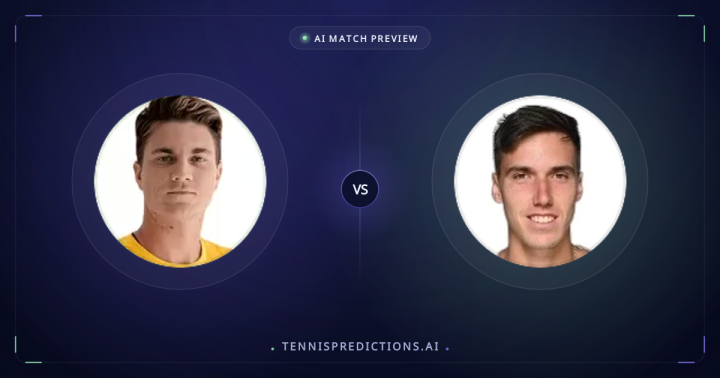
Miomir Kecmanović vs Fábián Marozsán Prediction: Winston-Salem Open Round of 32 Preview
The Winston-Salem Open often feels like tennis in a corridor of suspense. It arrives late in the North American summer, with the US Open already casting its long shadow, and it asks a simple but brutal question: who still has enough clarity, nerve and legs to win one more hard-court battle before New York?
On 2026-08-26 at 00:40:00 UTC, Miomir Kecmanović and Fábián Marozsán meet in the Round of 32 in Winston-Salem, USA. On paper, it is a tight ATP matchup. On court, it could become a fascinating duel between rhythm and disruption, between the Serbian’s structured baseline tennis and the Hungarian’s ability to change the geometry of a rally with one sudden strike.
The betting market gives Kecmanović the shorter price at 1.70, suggesting he is the more trusted player in conventional odds terms. Marozsán is listed at 2.25, and that is also where the AI-based prediction points: TennisPredictions.ai marks “2”, meaning the second player, Marozsán, to win. The confidence score, however, is only 1.0/10, which is a significant warning for bettors. This is not a loud, all-in verdict. It is more like a raised eyebrow from the algorithm.
The total games line is also important: Over 20.5 games at odds of 1.46. That number tells a story of its own. Even if the market leans slightly toward Kecmanović, it does not expect a walkover. It expects resistance, service holds, perhaps a 7-5 set, perhaps a tiebreak, perhaps three sets. In betting language, this is a matchup with upset potential, but also with enough uncertainty that the safer narrative may sit in the total games market.
Match Odds and Betting Context
The available odds shape the first layer of analysis:
Miomir Kecmanović to win: 1.70
Fábián Marozsán to win: 2.25
Over 20.5 total games: 1.46
AI prediction: Marozsán to win, confidence 1.0/10
There is a small wording issue in the supplied market description, where both prices were initially attached to a Kecmanović victory. In practical betting terms, the logical interpretation is Kecmanović at 1.70 and Marozsán at 2.25. That fits the match structure: Kecmanović as the marginal favorite, Marozsán as the live underdog.
For bettors, the contrast is interesting. The sportsbook odds make Kecmanović the favorite. The AI recommendation identifies value on Marozsán. The confidence score, though, is extremely low. That means the artificial intelligence model may see a slight edge in the underdog price, but not enough statistical separation to call it a strong play.
This is exactly the kind of tennis match where the outright winner market can be dangerous. One loose service game, one medical timeout, one hot return game, and the entire bet slips away. That is why the Over 20.5 games line deserves attention. At 1.46, the odds are shorter, but they reflect a more stable scenario: both players are good enough to hold serve regularly, both can stretch baseline rallies, and neither looks like an obvious straight-sets dominator.
For broader betting context and model-based tennis insights, resources such as Tennis Forecasts by AI can be useful when combined with human reading of form, surface, match tempo and market movement.
Kecmanović: The Control Player
Miomir Kecmanović has long been seen as a player built on balance. He is not always the loudest presence on the court. He is not usually the man producing the most spectacular highlights. But his tennis has a polished, professional seriousness to it. He can absorb pace, redirect the ball, defend from the back of the court and build points in clean layers.
On hard courts, that style can be extremely effective. Kecmanović likes rhythm. When he settles into a match, he can make opponents feel as if they are hitting into a wall that also knows how to counterpunch. He is comfortable in medium-length rallies, and he tends to trust his groundstrokes under pressure.
His forehand is a key weapon, not always a pure knockout punch, but a shot that allows him to control court position. His backhand, compact and reliable, helps him resist pressure from aggressive opponents. Against Marozsán, this matters because the Hungarian will not want to trade neutral balls forever. Marozsán wants to create angles, change direction and inject surprise. Kecmanović’s job will be to deny him that freedom.
The Serbian’s experience on the ATP Tour also counts. He has played enough tough matches to know that Winston-Salem can be awkward. Conditions can vary. Players are often managing fatigue. Some are already thinking about the US Open. Others are desperate for points and rhythm. Kecmanović’s professionalism may help him remain present in every game.
But the risk with Kecmanović is that his level can occasionally flatten. If he becomes too passive, if his first serve percentage drops, or if he allows Marozsán to step inside the baseline, the match can quickly turn. At 1.70, bettors backing him are not getting a huge price. They need him to be disciplined from the first return game.
Marozsán: The Dangerous Outsider
Fábián Marozsán is not the kind of underdog who can be ignored. His tennis has a sharp, expressive quality. He can look calm for several points, then suddenly cut open the court with a backhand angle or a fearless forehand acceleration. He is a player with imagination, and in modern tennis, imagination can be a weapon.
Marozsán’s rise has been built partly on his ability to trouble more established names. He does not always play by the most predictable patterns. That can be uncomfortable for someone like Kecmanović, who prefers order and structure. If Marozsán finds his timing early, this match can become much more complicated than the rankings or odds suggest.
The Hungarian’s best tennis comes when he serves well enough to protect his attacking instincts. If he is constantly under pressure on second serve, Kecmanović can pin him back and force errors. But if Marozsán earns cheap points behind the first serve and then attacks second balls on return, he has a realistic chance to control key moments.
At odds of 2.25, Marozsán is a tempting underdog. The AI prediction also leans his way. But the confidence score of 1.0/10 is the reality check. This is not a model screaming that the market is wrong. It is more likely a marginal value call based on price and matchup dynamics.
From a betting perspective, that makes Marozsán a risky but interesting moneyline selection. He may be the better value, but not necessarily the safer pick. His path to victory probably requires a high first-serve percentage, brave shot selection and emotional discipline in the longer games. If those pieces arrive together, he can absolutely win.
Tactical Story: Rhythm Against Invention
This match can be read as a tactical novel. Kecmanović wants to make it a disciplined baseline contest. Marozsán wants to create moments of disorder.
If Kecmanović controls the center of the court, he can force Marozsán to hit extra balls. That would favor the Serbian, especially if rallies become physical and repetitive. He will look to target Marozsán’s movement, keep depth through the middle, then open the forehand side when the chance appears.
Marozsán, meanwhile, needs to resist the temptation to overhit too early. His magic comes from variety, but variety without patience can become chaos. He must choose his attacks carefully. The short angle, the sudden backhand line, the drop shot if conditions allow it — these are the touches that can pull Kecmanović out of his comfort zone.
Serve plus one will be vital. Neither player is a classic servebot, so the serve is less about aces and more about building the first strike. Kecmanović may prefer body serves and wide patterns to set up his forehand. Marozsán may try to stretch the court earlier, especially on the deuce side, to create attacking angles.
Return games may decide the match. Kecmanović is usually patient enough to make returns and start points. Marozsán may be more explosive but also more variable. If the Hungarian steals a break early, he could become extremely dangerous. If he falls behind and has to chase, the error count may rise.
Why Over 20.5 Games Makes Sense
The Over 20.5 games market at 1.46 is the clearest betting angle in this preview. It is not glamorous, but it fits the matchup.
A straight-sets match can still go over this line if the sets are tight: 7-5, 6-4 produces 22 games. A single tiebreak makes the over very reachable. And if the match goes three sets, Over 20.5 is almost automatic unless one set is extremely one-sided.
Why does this line look logical? First, the moneyline odds are relatively close. A 1.70 favorite versus a 2.25 underdog suggests competitiveness. Second, the AI likes Marozsán but with very low confidence, which reinforces uncertainty rather than dominance. Third, both players have enough baseline quality to avoid being blown away easily. Fourth, Winston-Salem often creates matches where players are still fine-tuning hard-court rhythm before the US Open, which can lead to swings without complete collapse.
This does not mean Over 20.5 is guaranteed. Tennis never offers guarantees. A poor serving day, an injury, heat fatigue, or one player mentally checking out can ruin any total. But among the provided markets, it appears to be the most coherent selection.
Best tip: Over 20.5 total games at 1.46
AI Prediction: Useful, But Not Absolute
The AI prediction is Marozsán to win, listed as “2”, with odds of 2.25 and confidence of 1.0/10. That confidence number should be treated carefully. In sports betting, confidence levels matter as much as the pick itself. A low-confidence underdog prediction is not the same as a strong betting signal.
So how should bettors interpret it? The AI may detect that Marozsán’s price is slightly too high relative to his chances. It may see a matchup where his attacking profile can trouble Kecmanović. But it also recognizes the volatility. Kecmanović is the favorite for a reason: consistency, experience and reliable hard-court patterns.
A sensible bettor might therefore avoid loading too much stake on the underdog moneyline. Marozsán at 2.25 has appeal for those looking for value, but the total games market offers a more balanced route. If Marozsán wins, the match likely goes long. If Kecmanović wins, Marozsán still has enough quality to push at least one set deep.
Betting Tips and Final Prediction
This Round of 32 clash has all the ingredients of a late-summer ATP fight: a steady favorite, a creative underdog, a tight market and a total games line that seems to understand the story better than the winner odds alone.
Kecmanović will try to turn the evening into a measured contest of percentages. He will look for depth, patience and clean execution. Marozsán will try to bring sparks. He will want to hit through the court, vary the rhythm and make the Serbian defend in uncomfortable positions.
The final call is not easy. Kecmanović deserves favoritism because his game is generally more stable. But Marozsán at 2.25 is not a fantasy pick. He has the tools to win if he serves well and keeps his attacking errors under control. The AI’s lean toward Marozsán adds intrigue, but the confidence score prevents it from becoming a headline recommendation.
For bettors, the smartest play is to follow the shape of the match rather than chase the winner. A close contest is more likely than a quick demolition. That points directly to the total.
Best tip: Over 20.5 total games at 1.46
A secondary, higher-risk option is Marozsán to win at 2.25 for those seeking underdog value. But the main betting prediction remains the over, because it is supported by the odds structure, the player profiles and the expected tactical balance.
In the L’Equipe spirit, one might say this match will not necessarily be decided by the loudest shot, but by the quiet accumulation of pressure. Kecmanović will bring order. Marozsán will bring danger. Between them, Winston-Salem may get exactly what it loves most: a tense, readable, stubborn tennis battle that keeps bettors counting every game until the final handshake.