
Tennis Short-Turnaround Fatigue Explained
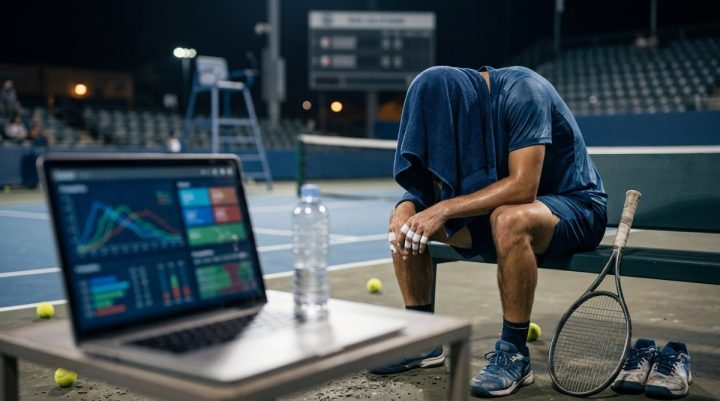
Why is counting days since the last match misleading?
The most common mistake is treating a player returning within 24 hours as fully recovered: tennis short-turnaround fatigue depends on workload, recovery time and travel rather than the calendar alone.
A straight-sets match lasting 68 minutes creates a different recovery problem from a three-hour contest ending in a deciding-set tiebreak. Start by recording minutes played, sets completed and finish time. Add signs of physical load, such as repeated long rallies, several medical timeouts or a final set in extreme heat. Avoid assuming that a 6-4, 6-4 score was easy; twelve deuce games could make it more demanding than a volatile three-set match filled with quick holds.
Rest hours provide a better first filter than rest days. A player finishing at 10:45 p.m. and starting again at 1:00 p.m. has barely 14 hours between matches, with media duties, food, treatment and sleep all squeezed into that window. Someone who finished at 2:00 p.m. before an evening match the next day may have more than 28 hours. Check scheduled start times before changing your price.
How should match length alter my estimated probability?
Match duration should modify an existing forecast, not replace it. Begin with serve quality, return strength, surface suitability and opponent level. Then apply a small fatigue adjustment when the workload is both unusual and relevant to the coming matchup.
Suppose your initial estimate gives Player A a 58% chance of winning. Fair decimal odds are calculated as 1 divided by 0.58, producing 1.72. Player A then plays for three hours and 12 minutes, finishes late and faces a rested opponent roughly 17 hours later. If the evidence makes you lower the win probability to 54%, the revised fair price becomes 1 divided by 0.54, or 1.85. A bookmaker offering 1.78 looked attractive before the adjustment but is now too short.
Use restrained changes. One long match does not automatically justify cutting a player by ten percentage points. A reduction of two to five points may be more defensible when there is limited recovery time, while no change may be appropriate after a routine match with a full day of rest. Record the adjustment before checking our tennis prediction engine, then compare the two views rather than copying either one blindly.
When does a back-to-back tournament become a real concern?
Reaching the closing rounds of one event before entering another matters most when the player must travel, change conditions and compete again within a few days. Merely appearing on consecutive tournament entry lists says little. Early elimination at the first event can provide several useful recovery and practice days.
A Sunday final followed by a Tuesday opening match deserves attention, especially if the tournaments use different surfaces. Moving from slow outdoor clay to a faster indoor hard court changes footwork, timing and rally length. The player may be physically capable but short of preparation in the new conditions. A first-round opponent who has practised at the venue for four days gains a specific advantage that season-long rankings may not capture.
Check the draw as well. An aggressive returner who attacks second serves can punish tired legs and rushed preparation more severely than a passive opponent. Price the actual matchup rather than applying a fixed “previous finalist” penalty. If the market has already moved from 1.65 to 1.82 after the schedule became clear, much of the concern may already be included.
Do travel and time zones matter on short turnarounds?
Travel matters when it removes recovery time or disrupts sleep, but distance alone is not enough. A two-hour flight can consume most of a day once airport transfers, baggage, treatment and tournament registration are included. Crossing several time zones adds a separate problem because the body may still expect sleep during the local afternoon or wake too early before an evening match.
Direction and arrival time deserve a note in your checklist. Travelling east usually asks the body to sleep earlier, while travelling west often requires staying awake later. Neither effect guarantees poor performance, and professional players may arrive early enough to adapt. The concern rises when a deep run delays departure and the next tournament begins almost immediately.
Avoid inventing precise penalties without evidence. Instead, grade the situation: low concern for short travel with two practice days, moderate concern for multiple time zones with one practice day, and high concern for overnight travel followed by a next-day match. Adjust more when the opponent is settled at the venue and less when both players have followed similarly demanding routes.
What role do heat, humidity and wind play in recovery?
Weather changes how demanding the previous match was and how fatigue may appear in the next one. Two hours in mild indoor conditions should not be treated like two hours in heavy humidity. Heat can make long service games and repeated changeovers physically costly, while humid conditions may slow recovery after an evening finish.
Wind adds a different strain. Players often use more footwork, safer targets and longer rally patterns when gusts disrupt clean ball striking. A match lasting only 95 minutes can still require constant adjustment. For the next round, ask whether the forecast repeats the same conditions and whether the opponent tends to extend points. Lingering tiredness matters more against a strong defender than against a high-risk hitter who keeps rallies short.
Do not double-count weather. If your base model already gives substantial weight to match duration and rally profile, avoid applying another full penalty simply because the temperature was high. Note one combined workload adjustment, then document why it was made. Consistent records will reveal whether your weather assumptions improve prices or merely provide a story after the result.
Can best-of-five tennis expose fatigue differently?
Best-of-five matches increase the possible cost of limited preparation because a player may need to maintain serve speed, movement and concentration for four hours or more. Early performance can still look normal. Fatigue may become visible only when recovery between explosive movements worsens in the third or fourth set.
Markets also behave differently by format. In best-of-three tennis, one loose service game can decide a set and leave little time for physical weakness to emerge. Best-of-five offers more time for the stronger player to recover from a slow start, but it also gives a well-prepared opponent more opportunities to extend rallies and test endurance. Avoid a simple rule that tired players should always be opposed in longer matches.
Consider alternative markets carefully. If a fatigued favourite remains technically superior but may fade late, a short match price could still be fair while a straight-sets bet is unattractive. Conversely, automatically backing a long match can fail when the tired player loses quickly. Keep the main question focused on win probability, then assess set or game markets separately.
Which checklist keeps fatigue adjustments disciplined?
Use the same sequence for every short-turnaround match so a dramatic deciding set does not dominate your judgment. First record the previous match’s duration, finish time and number of sets. Next calculate the approximate hours until the coming start. Add travel, time-zone changes, surface changes and expected weather. Finally, examine whether the opponent’s style is likely to expose reduced movement or recovery.
- Workload: Was the previous match unusually long for its format?
- Recovery: Are there fewer than roughly 20 hours between finish and restart?
- Journey: Did travel remove sleep, treatment or practice time?
- Conditions: Did heat, humidity or wind increase the physical cost?
- Matchup: Can the opponent extend rallies or attack weakened movement?
- Price: Has the market already shortened the rested player?
Require at least two meaningful warning signs before making a substantial change. A long match with 36 hours of rest may deserve little adjustment. A late three-set finish followed by travel, heat and an early start presents a stronger case. Keep a record of your original probability, revised probability and offered odds; otherwise, fatigue becomes an excuse that can be fitted to almost any result.
No scheduling angle makes a bet mandatory. Passing is sensible when finish times, travel details or conditions are uncertain, especially if the available edge is only one or two percentage points. Decide the stake with a clear head before the match, and never chase after it.