
AI Tips: Navone vs Rublev Predictions
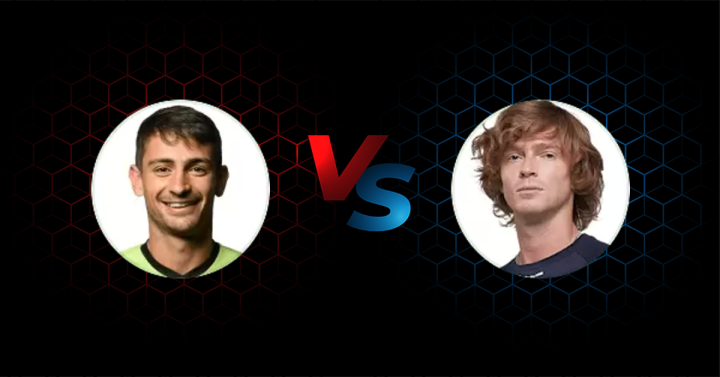
Match Overview
Mariano Navone and Andrey Rublev are lined up for a compelling Round of 32 showdown at the ATP Barcelona Open Banc Sabadell, one of the most tradition-rich stops on the European clay swing. As an ATP 500 event staged in Spain, Barcelona routinely attracts elite talent and rewards players who can combine heavy topspin, disciplined point construction, and the patience to finish in long rallies. This early-round pairing is a fascinating test of levels: Navone’s clay-court identity and hunger to prove himself on a big stage versus Rublev’s established power game and experience in high-pressure tour environments.
The match is scheduled for 2026-04-14 at 16:10:00 UTC, a slot that often brings lively conditions and a crowd that appreciates aggressive clay-court tennis—especially when a big-name contender is involved. From a tennis betting perspective, this is the type of matchup where market price, matchup dynamics, and total-games angles can matter more than “name value” alone.
Current Betting Odds and Market Snapshot
Odds at the time of writing show:
Mariano Navone to win: 2.27
Andrey Rublev to win: 1.66
There is also an AI-based signal from TennisPredictions.ai:
Top prediction: 2 (second player to win)
Confidence score: 2.1/10
Model odds reference: 1.66
One important note for bettors: the AI confidence is low (2.1/10). That doesn’t invalidate the pick, but it does suggest uncertainty—often caused by limited head-to-head data, volatility in recent form, or stylistic matchups that produce wider outcome ranges. In practical betting terms, low confidence usually means you should consider either smaller stake sizing or a market that reduces variance (for example, totals or set betting), depending on your risk tolerance.
Player Breakdown: Mariano Navone
Navone enters this matchup as the underdog, but the setting matters. Barcelona is played on clay, and Navone’s profile fits the surface: clay specialists and clay-leaning players can narrow the gap against higher-ranked opponents by extending rallies, exposing movement patterns, and forcing extra shots under pressure.
From a tactical angle, Navone’s best path is typically built around:
1) Depth and height to the Rublev backhand wing to reduce first-strike damage.
2) A high workload approach—making the match physical and testing patience.
3) Selective aggression, choosing the right moments to step in rather than trading flat pace all day.
For betting enthusiasts, Navone’s underdog price (2.27) reflects both the challenge of facing an established top-tier opponent and the reality that clay can compress the gap if the favorite’s timing is off. If Navone starts well and turns the match into a grind, live-betting opportunities may appear—especially if Rublev’s error count rises in longer exchanges.
Player Breakdown: Andrey Rublev
Rublev is priced as the favorite at 1.66, and the logic is straightforward: he’s one of the tour’s most recognizable power baseliners, capable of taking time away and dictating with pace. On clay, that power can still translate, but it often requires better shot tolerance and smarter margin management—because the surface gives defenders extra time and punishes low-percentage aggression.
Rublev’s typical winning formula on clay includes:
1) First-strike forehand patterns to open the court and finish early.
2) Strong return pressure, especially against second serves, to create immediate scoreboard stress.
3) Controlled aggression—hitting heavy through the court while accepting that some points must be constructed.
From a betting market standpoint, Rublev at 1.66 implies he wins this matchup more often than not, but not at “lock” territory. That aligns with the AI model’s pick (second player to win) while also matching the model’s low confidence: Rublev is favored, yet the clay context and Navone’s potential to extend rallies introduce enough uncertainty to keep the price relatively honest.
Key Matchup Factors That Can Decide the Outcome
Baseline tempo: If Rublev consistently lands the first heavy blow, Navone may struggle to get into neutral rallies. If Navone absorbs pace and keeps the ball deep, Rublev can be forced into riskier lines.
Serve + first ball: On clay, free points are rarer. The player who wins more “serve +1” patterns usually controls momentum. Rublev’s ability to attack second serves could be a major swing factor.
Length of rallies: Longer rallies generally favor the player who can maintain height, spin, and patience without leaking errors. If points regularly stretch past 6–8 shots, totals markets become more attractive.
Emotional control and momentum: Clay matches can swing quickly with a couple of long games. A single extended hold or break can reshape the set, which is why totals and live markets often outperform pre-match moneyline value in these spots.
AI Prediction and What It Means for Bettors
TennisPredictions.ai points to Player 2 to win (Rublev) with odds of 1.66, but the confidence score is only 2.1/10. The best way to interpret that is: the model leans Rublev, yet expects volatility. For bettors, that can mean:
– Avoid overexposure on the moneyline if you dislike variance.
– Consider totals (games) if you expect Navone to compete in stretches even in a loss.
– Watch early service games for live confirmation (Rublev timing vs. Navone rally tolerance).
Best Betting Tips (Pre-Match)
Best Tip: Over 19.5 Total Games (1.40)
The suggested total is O19.5 at odds of 1.4. This line is often reachable in several common match scripts on clay:
– A competitive two-set match (for example, 6-4 6-4 = 20 games).
– One tight set plus one more routine set (7-5 6-3 = 21 games).
– Any three-set scenario clears comfortably.
Why it fits this matchup: Navone’s clay profile can help him hold enough to push sets deeper, while Rublev’s favorite status still allows him to win without necessarily producing a short, one-sided scoreline. Given the AI’s low confidence on the outright winner, a totals angle can be a cleaner way to express “competitive match” without needing to pick the exact winner.
Secondary Lean: Rublev Moneyline (1.66)
If you prefer a straightforward winner market, Rublev at 1.66 aligns with both the market and the AI’s top pick (Player 2). The case is simple: Rublev’s power and return pressure can overwhelm if he keeps his unforced errors under control. Still, because the confidence rating is low, many bettors will treat this as a smaller-stake play or pair it with a safer market rather than making it the only position.
Final Thoughts for Tennis Betting Fans
This Barcelona Round of 32 match offers a classic clay-court betting puzzle: an established favorite with clear weapons versus an underdog whose best chance is to turn the contest into a physical, high-rally grind. The market favors Rublev, the AI leans Rublev as well, but the uncertainty signal points toward a match that could feature enough competitiveness to make the totals market especially appealing.
If you’re building a tennis betting card for ATP Barcelona, prioritize value, manage stake sizing, and consider watching the first few games for live-betting confirmation—especially around rally length, second-serve pressure, and whether Navone can consistently neutralize Rublev’s forehand patterns.