
Medical Time-Out Tennis Betting Explained
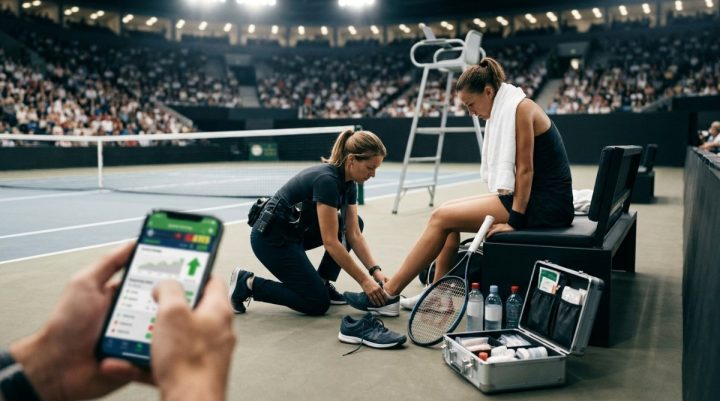
A player leads 4-3 in the deciding set, calls the trainer for a leg problem, and suddenly drifts from 1.65 to 2.20. A medical time-out is a permitted pause for assessment and treatment, not a retirement, so play and most bets remain live.
What actually happens during an MTO
A medical time-out, often shortened to MTO, allows a player to receive treatment for a physical condition during a match. The trainer may first assess the problem and then provide a limited treatment period under the competition’s rules.
Treatment might address a thigh strain, blister, back spasm or another issue that can be treated safely courtside. Timing and eligibility can vary by tour, tournament and condition, which is why bettors should avoid assuming every pause follows an identical sequence.
An MTO is different from routine attention during a changeover. A player may receive brief treatment between games without taking a formal medical time-out, while some issues can be treated only at particular moments. Commentary, on-screen graphics or official scoring feeds may clarify which type of intervention is occurring.
The crucial betting point is simple: the match has not ended. Pre-match bets normally remain active, live markets may be suspended temporarily, and prices can reopen once the bookmaker believes it has enough information.
Suspension protects the bookmaker from accepting bets while the player’s condition is unclear. It does not mean bets already placed have been cancelled. Settlement still depends on the final result and the operator’s retirement rules if the player later stops.
Why one treatment break can move the price sharply
Tennis has no substitute bench. A physical problem affects the same player on every serve, return and change of direction for the rest of the match, so even a small decline can alter the likely outcome.
The score determines how much damage the injury must cause before the match price changes materially. A player leading 5-1 in the final set may remain a strong favorite despite restricted movement, while a player serving at 3-4 faces immediate danger because one poor service game could decide the match.
The affected body part also matters. A right-handed player receiving treatment on the right shoulder could lose serve speed, but a taped finger may have little visible effect. A leg issue could hurt wide-ball coverage, serve drive and recovery after long rallies, especially on a slower court.
Visible evidence after treatment is more useful than the mere appearance of a trainer. Check the following points before considering a live bet:
- First-serve speed: A sustained drop of 15 km/h matters more than one cautious serve immediately after the break.
- Movement to both sides: A player may run normally forward but protect a leg when pushed wide.
- Point construction: More drop shots or rushed attacks can indicate an attempt to shorten rallies.
- Serve location: Repeated body serves may reflect reduced confidence in producing wide angles.
- Changeover behavior: Further treatment requests are more informative than facial expressions alone.
- Score pressure: Movement problems become more expensive when the affected player must protect a narrow lead.
Surface adds context. Clay demands repeated sliding and recovery, so a lower-body limitation can be exposed over long exchanges. Fast hard courts may help an injured player shorten points with serve and first-strike tennis, although abrupt stopping can still test the legs.
Never reduce the judgment to “trainer equals serious injury.” Players sometimes resume at close to normal capacity after treatment, and the market can overreact because live bettors see an alarming interruption but cannot yet see its practical effect.
How bookmakers handle open bets
Medical time-out tennis betting has two separate questions: what the interruption says about the next points, and what the bookmaker will do if the match is not completed. Mixing them creates avoidable mistakes.
A completed match is usually straightforward. If the treated player continues and wins 7-6, 3-6, 6-4, a match-winner bet is settled on that result. The presence of an MTO does not normally change the settlement.
Retirement creates more variation. One sportsbook may require the entire match to be completed for match-winner bets, another may settle once a first set has been completed, and another may grade the player who advances as the winner. Rules can also differ between pre-match and live bets.
Set, game and player-prop markets require separate attention. A completed first-set winner bet may stand even if a retirement occurs in set two, while an over-games bet that has not already reached its required total may be void. Some operators settle markets whose outcomes are mathematically determined and cancel the rest.
Suppose over 20.5 games has already reached 21 completed games before a retirement. A bookmaker that settles unconditionally decided markets may grade the over as a winner because no later event can reduce the game count. A different operator may void all total-games bets on any retirement, so the written house rule still controls.
Read the exact tennis rules at the sportsbook holding your stake, not a summary copied from another operator. A useful betting process keeps a note of each bookmaker’s retirement policy beside its available markets and uses tennis predictions as analysis rather than as a substitute for settlement terms.
Pricing the pause without guessing
Consider a deciding set tied at 3-3. Player A was priced at 1.70 immediately before calling for treatment on the left thigh, and the market reopens with Player A at 2.25 after the MTO.
The first calculation converts both decimal prices into raw implied probabilities:
- Before treatment: 1 ÷ 1.70 = 0.5882, or 58.82%.
- After treatment: 1 ÷ 2.25 = 0.4444, or 44.44%.
- The raw change is 58.82% − 44.44% = 14.38 percentage points.
Bookmaker margin means neither figure is a perfect fair probability, but the comparison shows the scale of the market’s injury adjustment. The price is effectively asking whether Player A’s chance has fallen from roughly three in five to below one in two.
Assume the first two games after treatment provide useful evidence. Player A holds serve to 30, first-serve speed is only 3 km/h below the earlier level, lateral movement looks functional, and no point ends with an obvious restriction. Your revised estimate might be 49%, not the market’s raw 44.44%.
Expected value at odds of 2.25 can then be calculated step by step:
- Estimated win probability: 0.49.
- Return when the bet wins: 2.25 × €20 = €45, including the €20 stake.
- Profit on a win: €45 − €20 = €25.
- Expected profit: (0.49 × €25) − (0.51 × €20) = €12.25 − €10.20 = €2.05.
- Expected return on stake: €2.05 ÷ €20 = 10.25%.
A positive calculation does not guarantee the player is healthy or that the bet wins. It says odds of 2.25 are attractive if the 49% estimate is well founded and the settlement rules are acceptable.
Estimation error deserves respect because two post-treatment games are a tiny sample. Requiring a larger edge than usual can compensate for missing information, while a smaller stake limits the cost of being wrong about an injury that worsens suddenly.
Score state must remain inside the estimate. Holding one service game does not prove full recovery if the opponent is about to serve with new balls, nor does one lost rally establish serious damage. Price the route from the current score, including who serves next and how many breaks are required.
Where MTO bettors pay too much
Backing the opponent before play resumes
The first reaction is often to bet against the treated player before seeing another point. Live odds may already contain a large injury adjustment, so an apparently obvious bet can mean buying the opponent at the worst available price.
Waiting has a cost because the market may move quickly, but uncertainty also has a cost. No bet is preferable to accepting 1.45 when your evidence supports only a 65% chance, which corresponds to fair odds of about 1.54.
Treating body language as a medical report
A grimace, slow walk or frustrated gesture can follow fatigue, pain or annoyance after losing a point. None measures how much serve speed, balance or court coverage has actually changed.
Track repeatable actions instead. Three consecutive service games with reduced pace and limited leg drive carry more weight than a player stretching once behind the baseline.
Ignoring the sportsbook’s retirement clause
A bettor may find value in the price yet choose the wrong operator for the intended outcome. If the injured player is likely either to recover and win or retire, a sportsbook that voids the match-winner market on retirement creates a different bet from one that settles the advancing player as the winner.
Check rules before the match whenever possible. Trying to interpret unfamiliar wording while the live clock runs invites expensive assumptions.
Assuming every injury hurts immediately
Adrenaline, pain relief and tactical changes can allow a player to compete effectively for several games. A server who cannot defend long rallies may still hold comfortably by landing first serves and attacking the next ball.
The effect can also arrive late. A restricted player may survive at 4-4 but deteriorate in a tiebreak or after another demanding changeover, making short-term evidence useful without making it conclusive.
Increasing the stake because retirement seems likely
A possible retirement can feel like certainty, particularly when the opposing player needs only a few games. Settlement uncertainty and sudden recovery make oversized stakes especially dangerous in this spot.
Use the same percentage of bankroll applied to other uncertain live bets, or reduce it. Injury information is noisy, and a perceived edge does not justify risking several normal stakes on one courtside assessment.
Forgetting that the market also sees the problem
An MTO is public information. Traders, automated models and thousands of bettors can all react, so recognizing an injury does not create an edge by itself.
Value comes from estimating the effect more accurately than the reopened price. If the market moves Player A from 1.70 to 2.25 and your estimate is also around 44%, there is no useful disagreement to bet.
Medical time-outs: four questions before betting
Does an MTO automatically void my bet?
No. A medical time-out is only a temporary interruption, and bets normally stay active if the match resumes and finishes. A later retirement may trigger special settlement rules, depending on the market and sportsbook.
Should I immediately bet against the player receiving treatment?
Usually not without checking the new price and observing play after treatment. A real physical problem can still be fully reflected—or overreflected—when the market reopens.
Are lower-body problems always worse on clay?
Clay can expose restricted sliding, recovery and endurance, but the score and playing style still matter. A strong server needing one more hold may be less affected than a defensive player facing several long return games.
How many points should I watch after the break?
No fixed number guarantees a sound assessment, although one isolated point is rarely enough. Look for repeated changes across serve speed, movement and rally choices, then compare your estimated probability with the available odds rather than betting solely on the visible injury.
An MTO creates uncertainty, not free money, so combine the score, post-treatment evidence, price and settlement policy while keeping the stake modest. The best staking plan is the one that keeps you in the game after five losses in a row.