
Stefanos Sakellaridis vs Marco Cecchinato: Forecasts
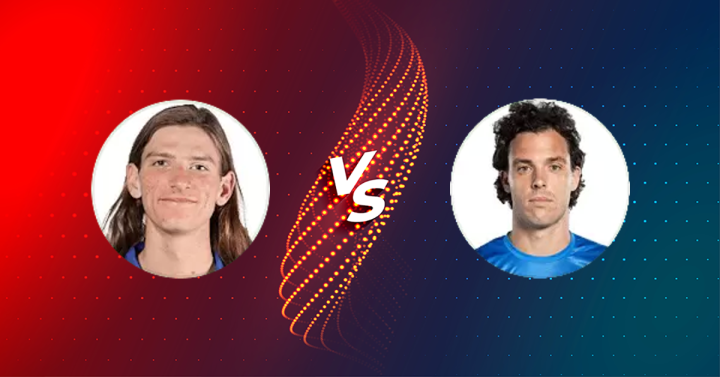
Match Overview
The ATP French Open qualifying draw always has a special kind of tension: it’s where reputations are tested, legs are heavy from spring clay miles, and every point can feel like a referendum on a player’s season. On May 20, 2026 (09:00:00 UTC) in Paris, Greece’s Stefanos Sakellaridis steps into one of the most challenging auditions in tennis—facing Italy’s Marco Cecchinato, a veteran whose name is practically synonymous with clay-court craft.
This matchup is a classic qualifying storyline: the hungry rising talent trying to prove he belongs on the sport’s biggest clay stage versus the seasoned specialist who knows exactly how to win ugly, win smart, and win when it matters. With odds listing Sakellaridis at 2.06 and Cecchinato at 1.75, the market leans toward the Italian—reflecting both experience and surface suitability.
Odds, Market Read, and AI Betting Angle
From a betting perspective, the pricing tells a clear story:
– Stefanos Sakellaridis to win: 2.06
– Marco Cecchinato to win: 1.75
Our platform’s Artificial Intelligence model has flagged the best side as 2 (Marco Cecchinato to win) with a confidence rating of 1.4 at odds of 1.75. That’s not a “lock” signal—confidence is modest—but it is a directional edge that aligns with how clay-court qualifying often plays out: experience, point construction, and emotional control tend to matter more than raw shot-making.
On totals, the model also points to a potentially efficient match length:
– Total Games Prediction: Under 26.5 at 1.53
Under 26.5 suggests a match that avoids a marathon—either via a straight-sets outcome or a three-setter that doesn’t spiral into multiple tiebreaks and extended service holds. On clay, where breaks are more common than on faster surfaces, unders can be live when one player is better at grinding return games and managing patterns.
Player Snapshot: Stefanos Sakellaridis
Sakellaridis arrives with the kind of profile bettors love to track in qualifying: a developing player with upside, a willingness to compete, and the potential to outperform his current market perception. Greek tennis has produced a wave of attention in recent years, and while Sakellaridis isn’t priced like a headline act here, he represents that same national pipeline of ambition—players who grow up understanding that clay seasons can define careers.
Stylistically, younger players in this tier often bring a few consistent traits into clay qualifiers:
– They’re prepared to extend rallies but may still be learning when to pull the trigger.
– They can surge early in matches, then face a tactical “second wave” once opponents adjust.
– Their biggest swing factor is usually serve-plus-one efficiency—how often they can start points on their terms rather than getting dragged into chess matches.
If Sakellaridis is going to flip this matchup, he likely needs to do it with proactive tennis: taking time away when possible, stepping into forehands, and making Cecchinato defend in uncomfortable court positions rather than allowing the Italian to dictate with shape, height, and angles.
Player Snapshot: Marco Cecchinato
Cecchinato is the kind of opponent qualifiers dread drawing: a clay-court veteran with deep pattern knowledge and the patience to win points in five different ways. Even when he’s not at his peak, his game tends to translate on this surface because it’s built around repeatable clay fundamentals—heavy topspin, controlled aggression, and an ability to turn defense into neutral positions.
What makes Cecchinato particularly relevant in Paris is that he’s not learning the environment. He understands the rhythms of French clay, the way the ball sits up, and how quickly momentum can swing when a player gets frustrated by “one more ball.” In qualifying, that mental steadiness can be worth as much as a few extra km/h on serve.
From a betting lens, veterans like Cecchinato often win matches in ways that don’t always look dominant on highlight reels:
– They absorb early pressure and let opponents overplay.
– They target backhand exchanges and patiently wait for short balls.
– They win the “middle” of sets—games 4 through 9—where focus dips and patterns repeat.
Tactical Keys That Could Decide the Match
1) Rally Tolerance and Shot Selection
Clay rewards discipline. If Sakellaridis tries to end points too quickly, Cecchinato’s experience in reading patterns can turn that into a steady stream of errors. If Sakellaridis stays patient but passive, Cecchinato can slowly take over with depth and angles. The sweet spot for the Greek is controlled aggression—building points with intent rather than rushing.
2) Return Games and Break Conversion
Qualifying matches on clay often come down to who converts more break chances. Even a small edge in return quality can snowball into a set. Cecchinato’s profile typically fits the “break-first” archetype, while Sakellaridis may need to protect serve early to settle nerves and keep the scoreboard pressure balanced.
3) Emotional Management in Paris Conditions
Paris qualifying can be a grind: long days, shifting weather, and the psychological weight of being one match closer to the main draw. Cecchinato has lived this. Sakellaridis is still building that library of experiences. If the match tightens late in a set, the veteran’s calm decision-making can become a decisive edge.
Best Tip and Total Games Prediction
For bettors looking for a clear, model-backed angle, the platform’s top recommendation is the moneyline:
– Best Tip: Marco Cecchinato to win (2) at 1.75 (AI confidence: 1.4)
And for totals players:
– Under 26.5 games at 1.53
These two positions can complement each other logically: if Cecchinato’s experience leads to a controlled win—especially in straight sets—the under becomes more attractive. Even in three sets, the under can still land if one set is lopsided or if breaks come in clusters rather than extended hold-fests.
Final Betting Takeaway
This is the kind of French Open qualifying match that blends aspiration with realism. Sakellaridis brings the energy of a player trying to announce himself on a major stage, while Cecchinato brings the clay-court fluency of someone who knows how to turn that energy into mistakes. With the odds shading toward the Italian and the AI model reinforcing that direction, the value play—based on experience, surface logic, and match dynamics—leans to Marco Cecchinato to win, with Under 26.5 games as a secondary angle for bettors who like totals.
As always, stake responsibly, respect variance in qualifying matches, and consider live-betting opportunities—because on clay in Paris, momentum can change fast, but the smartest players (and bettors) are the ones who adjust even faster.